Buy or sell in Boston, Newton, Needham, Brookline, Wellesley, and Somerville with clear guidance, local insight, and a calm, strategic process. Serving Boston, Somerville, Newton, Brookline, Wellesley and Needham, MA.
# May's Inventory Mirage: Why Boston Buyers Are Rejecting the Fixer-Upper
Key Takeaways
•The Core Answer: Buyers feel shut out because the "new" inventory is heavily padded with stale, overpriced, or repair-heavy properties that families cannot afford to fix, creating a mirage of choice.
•The Myth: A seasonal bump in listings means an easier, more affordable buying experience for the average family.
•The Reality: Move-in ready homes are still triggering intense bidding wars, while repair-heavy homes are lingering longer; citywide median Days on Market is 73 days, but that broad figure masks a sharper split between turnkey listings and fixer-uppers.
•The Bottom Line: Winning in today's market requires targeting "lightly worn" homes and treating the first open house as the final deadline.
More Boston listings should mean an easier path to homeownership. That's the logical assumption—and right now, it's misleading a lot of buyers.
If you're still feeling shut out in May 2026, you're not imagining it.
Boston inventory is improving. The problem is that affordable, workable, move-in ready inventory is not improving at the same pace. What looks like relief on a listing app often feels very different once you're touring homes, running payment numbers, and thinking seriously about repair costs.
Is the Illusion of Choice Ruining the Boston Spring Housing Market?
Open your home search app right now and you'll probably see more listings across Greater Boston than you did a month ago.
On paper, that sounds encouraging. Mid-May active inventory is up roughly 18 percent versus mid-April, and active listings are up 16.2 percent year over year heading into the spring.
Those two figures are related, but they measure different things. The 18 percent increase captures the recent seasonal build from mid-April to mid-May. The 16.2 percent year-over-year figure compares this spring's active listings against the same period last year. Together, they confirm that supply is improving—both seasonally and annually.
But a higher listing count doesn't automatically mean a better pool of choices for payment-sensitive households. That's the gap worth understanding.
Boston Housing Market Snapshot, 2026
Headline Boston market indicators mixing price, supply, pace, and mortgage-rate metrics; a snapshot card is best because units differ.
Prices
Market pace
Supply
Financing
Headline Boston market indicators mixing price, supply, pace, and mortgage-rate metrics; a snapshot card is best because units differ.
Series
Label
Value
Prices
Boston median sale price (2026)
$721,667
Prices
Boston YoY price change (2026)
+0.7%
Market pace
Properly priced single-family average days on market
This is why so many buyers still feel locked out. The market isn't short on addresses. It's short on homes that make financial sense.
A large share of the "new" inventory is made up of properties that are:
•Overpriced for their condition
•Lingering from earlier weeks
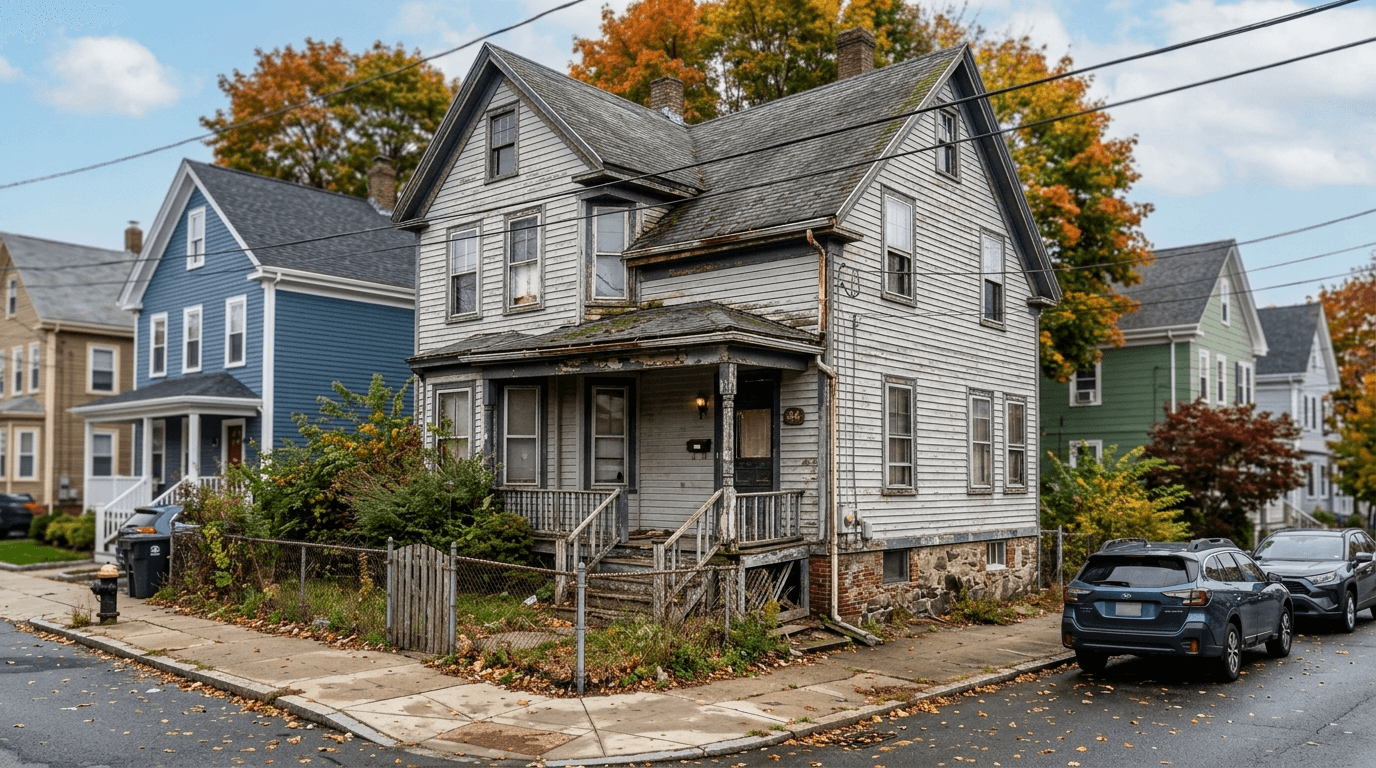
•In need of major updates or repairs
•Too risky for buyers already stretched by today's mortgage rates
So even with a 16.2 percent increase in listings, you're not necessarily competing less. In many cases, you're just scrolling past a bigger pile of homes other buyers already passed on.
Why Are Turnkey Homes Selling While Fixer-Uppers Become Money Pits?
This is the sharpest divide in Boston right now—and it's not subtle.
Turnkey homes are moving fast. Homes that need major work are not.
That split makes complete sense when 30-year fixed mortgage rates are hovering around 6.4 percent. At that rate, buyers are already making a serious monthly commitment before they even think about a kitchen overhaul, electrical updates, or foundation work. Layer those costs on top, and the total picture can push well past what feels financially safe.
The following visual tracks the financing backdrop behind that behavior—pairing the rate environment with the affordability pressure buyers are already carrying before they budget a single dollar for repairs.
Citywide median Days on Market has climbed to 73 days. That broad figure can make the entire city look slower than it actually feels on the ground. The more useful lens is segmented performance by property condition. Turnkey and lightly updated homes are still attracting fast, competitive action. Fixer-uppers are far more likely to drift past 45 days and keep dragging the broader median upward.
This next chart breaks out market time by listing segment—separating the citywide median from the slower repair-heavy subset and the faster move-in-ready subset. It's the clearest way to understand why one home gets mobbed while another sits untouched.
Boston Median Sale Price Trend, 2022-2026
A time-series view of Boston house prices shows how the market climbed from 2022 through 2026.
A time-series view of Boston house prices shows how the market climbed from 2022 through 2026.
One number is hiding two completely different markets:
•Well-priced, move-in ready homes can still go quickly with multiple offers.
•Fixer-uppers and overreaches can sit for weeks with little traction.
•The citywide median DOM of 73 days reflects both—including stale inventory that pulls the average experience in a direction most active buyers never encounter.
When buyers say, "There's more inventory, but I still can't buy," this is almost always what they mean.
Is the 'Worst House on the Best Block' Strategy Dead?
For most buyers in this market—yes, or at least mostly.
For years, the conventional wisdom was to buy the ugliest home in a great neighborhood and build equity through renovation. In 2026, that strategy is much harder to execute because the full ownership math has changed.
Buyers now have to account for:
•Higher borrowing costs
•More expensive insurance
•Higher utility bills
•Elevated labor and contractor pricing
•Real uncertainty around renovation timelines
This visual focuses on renovation exposure and total cost of ownership—highlighting the categories that turn a "discounted" purchase into a far more expensive one once repairs, systems updates, and carry costs are factored in.
Boston vs U.S. Median Sale Prices, 2022-2026
Grouped bars compare Boston's median sale price against the national median across the same years using one shared unit: dollars.
A fixer-upper isn't just a project anymore. It can become a second financial stressor stacked on top of an already expensive mortgage.
According to a recent Realtor.com analysis, turnkey homes Boston buyers choose can save an average of $25,335 over the first 10 years in energy, HVAC, and roof replacement costs alone.
That's real cash flow protection—not a footnote.
A Boston-area agent on our team put it plainly: buyers often walk away the moment inspection findings reveal structural work substantial enough to change the total cost of ownership. That reaction isn't fear—it's rational. When an inspection uncovers foundation, structural, or major systems issues, the "deal" stops looking like a bargain and starts looking like a budget trap.
This chart stays focused on exactly that risk: repair burden, inspection-related concerns, and buyer response when a property's economics no longer pencil out. Neighborhood appeal can support long-term value, but it doesn't erase renovation risk.
Boston Crime Rates per 1,000 Residents
A simple bar chart gives general readers a quick sense of Boston's crime-rate levels using a consistent per-1,000-residents unit.
A simple bar chart gives general readers a quick sense of Boston's crime-rate levels using a consistent per-1,000-residents unit.
Even on a beautiful street, in a walkable neighborhood near strong schools, buyers are increasingly arriving at the same conclusion: location still matters, but it doesn't cancel out bad numbers.
Where Are Boston Bidding Wars Still Raging?
They're alive and concentrated—specifically in the price bands and neighborhoods where buyers see the best combination of stability, convenience, and minimal near-term repair risk.
A large cohort of family buyers in the 35-to-45 age range delayed moves through 2024 and 2025. Many of them are now trying to buy before the next school year starts. That urgency is compressing demand into a narrow window, and it shows.
This visualization maps where buyer activity is clustering and how competition remains concentrated around homes with the fewest immediate repair unknowns—helping explain why bidding wars persist even as broader inventory counts rise.
Neighborhood Price Band and Competitive Market Metrics
Because so many buyers are actively avoiding heavy projects, they're all circling the same type of home:
•Move-in ready
•Functional layout
•Good neighborhood fit
•No immediate major capital expense
In those micro-markets, days on market can effectively feel like single digits.
If you've toured one clean, well-priced home and felt like the entire city showed up alongside you—that's not your imagination. The competition is still intense precisely where the inventory is actually usable.
How Can Buyers Navigate the Mirage and Actually Win?
Sitting back and hoping the market suddenly becomes easy isn't a strategy. With the Fed signaling a likely hold through the summer, waiting on a dramatic rate drop probably won't improve your position soon enough to matter.
The better move is to adjust your approach to the market that actually exists.
Pending sales rose roughly 9.2 percent month over month—and that tells us something important. Demand hasn't disappeared. It's being selectively deployed toward the homes buyers believe they can live in and finance with confidence.
This chart tracks that recent pending-sales movement and shows how buyer activity is still advancing even in a market where headline inventory numbers can be misleading.
Boston Median Sale Price Trend, 2022-2026
A time-series view of Boston house prices shows how the market climbed from 2022 through 2026.
A time-series view of Boston house prices shows how the market climbed from 2022 through 2026.
•Secure a fully underwritten pre-approval. A basic pre-qualification often isn't enough in competitive situations.
•Run your numbers at current rates. Base affordability on roughly 6.5 percent, not on optimism.
•Treat the first open house like the real deadline. In many Boston submarkets, it is.
•Use inspections strategically. You still need protection—but the goal is smart risk management, not automatic deal collapse.
•Target "lightly worn" homes. These often offer the best balance of reduced competition and manageable improvement costs.
That last point is worth sitting with.
The smartest opportunities right now may be homes that are not perfect, but not broken. Dated paint, older finishes, cosmetic wear—those are workable. Six-figure structural surprises are not. A lightly worn home can give you a real opening in a market where the truly turnkey options are getting swarmed.
So Why Do Buyers Still Feel Shut Out Even If Inventory Is Improving?
Because what's improving is the count of listings—not necessarily the quality of options.
This final visual ties the full picture together by comparing visible inventory growth with the narrower subset of homes buyers can realistically pursue without taking on major repair risk.
Boston Housing Market Snapshot, 2026
Headline Boston market indicators mixing price, supply, pace, and mortgage-rate metrics; a snapshot card is best because units differ.
Prices
Market pace
Supply
Financing
Headline Boston market indicators mixing price, supply, pace, and mortgage-rate metrics; a snapshot card is best because units differ.
Series
Label
Value
Prices
Boston median sale price (2026)
$721,667
Prices
Boston YoY price change (2026)
+0.7%
Market pace
Properly priced single-family average days on market
When you're the one making the mortgage payment, covering the repairs, and protecting your family's budget, that distinction matters far more than any headline number.
If you want help identifying which Boston neighborhoods still hold real opportunity—and which listings are simply adding to the mirage—reach out and we'll break down the numbers for your specific price range and target areas.
Common Questions
What does “improving inventory” actually mean in the Boston housing inventory right now?
Improving inventory means more homes are listed, not that better homes are available. In the Boston real estate market, much of the added supply consists of stale listings, overpriced properties, or homes needing major repairs, so buyers see more choices online but still struggle to find affordable, move-in ready options.
How can buyers tell whether a Boston fixer-upper home is a deal or a financial trap?
Buyers should compare the purchase price plus renovation, insurance, utility, and financing costs against a comparable turnkey home. In the Boston real estate market, many Boston fixer-upper homes look cheaper upfront but become more expensive once roof, HVAC, foundation, or electrical work is added to the total cost.
Is the rise in days on market a sign that the Boston real estate market is cooling?
Not necessarily. In the Boston real estate market, higher days on market often reflect overpriced or repair-heavy homes lingering unsold, while well-priced turnkey homes still move fast. That makes the market feel slower in the data but still highly competitive for the homes most buyers actually want.
Can buyers still win in the Boston real estate market without waiving every contingency?
Yes, buyers can still compete without waiving every protection if they are fully underwritten, move quickly, and target the right homes. In the Boston real estate market, strong offer terms, flexible timing, and smart inspection strategies often matter more than blindly removing every contingency.
Does buying a lightly worn home make more sense than buying a fixer-upper in Boston?
Lightly worn homes often make more sense because they need cosmetic updates instead of expensive structural repairs. In the Boston real estate market, these homes can attract slightly less competition than turnkey listings while avoiding the budget shock that makes many Boston fixer-upper homes feel unaffordable after closing.
Will Boston buyers feel less shut out if mortgage rates stay near current levels?
Buyers may adjust, but they may not feel much relief unless quality supply improves. In the Boston real estate market, steady rates help with planning, yet families still feel shut out when the available Boston housing inventory is dominated by outdated, overpriced, or high-repair homes.