Key Takeaways
•The Neighborhoods: Boston's residential map runs from the luxury core (Back Bay, Beacon Hill, Downtown, Seaport, the Fenway/Longwood corridor) through walkable mid-tier neighborhoods (South End, Charlestown, Jamaica Plain, South Boston) to the more practical, family-driven outer ring (Dorchester, East Boston, Roslindale, West Roxbury, Brighton).
•The Split: The luxury tier is cash-driven and largely insulated from rates. Many mid-tier neighborhoods are more rate-sensitive, and the 6.490% APR (the all-in yearly cost of a mortgage, including fees) reported in Gibson Sotheby's June 2026 market report is a factor for financed buyers.
•The Bottom Line: Boston is operating as two distinct markets right now. Citywide signals are still healthy — sale-to-list at 100%, prices up year over year — but inventory growth in some neighborhoods means pricing strategy now varies sharply by ZIP code.
If you're trying to make sense of Boston's neighborhoods in mid-2026 — what each one is actually doing, not just what the headlines say — here's the honest map.
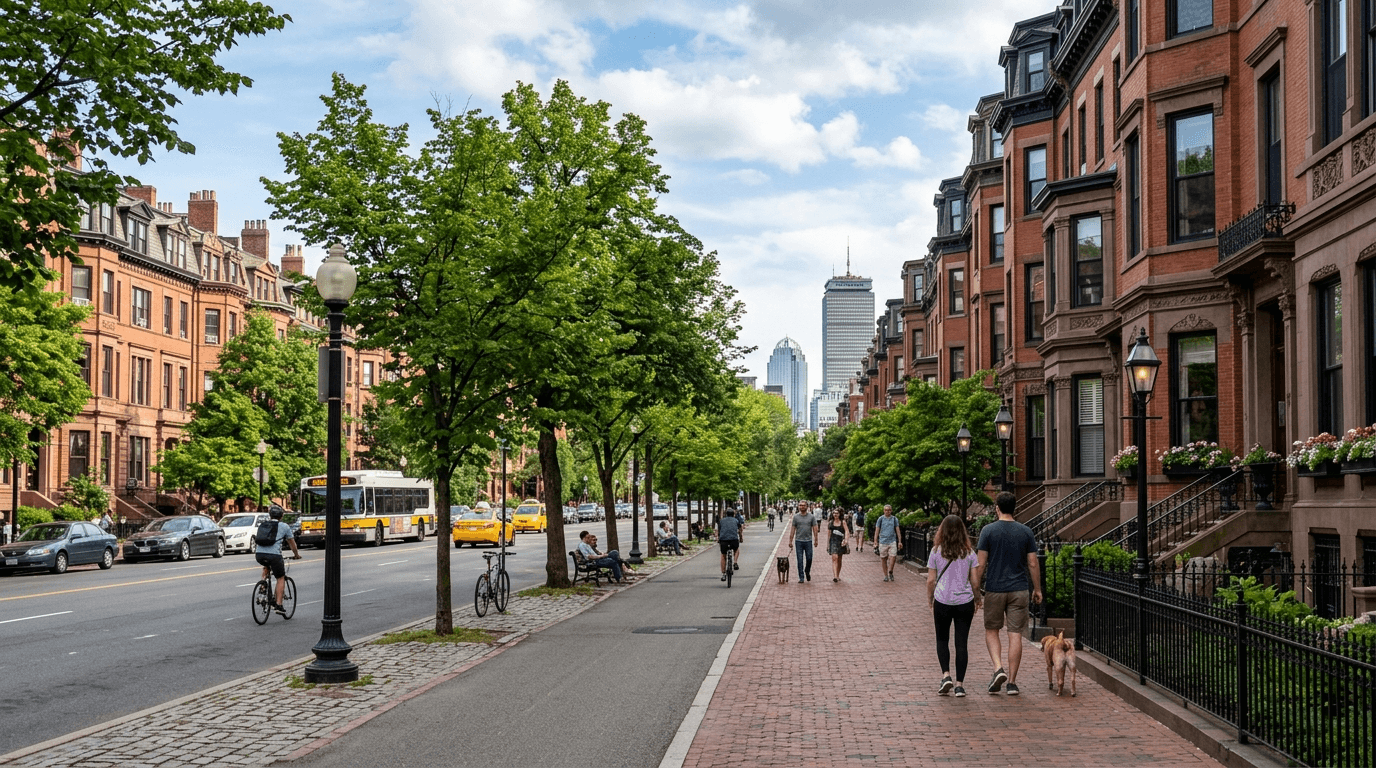
The luxury core: Back Bay, Beacon Hill, Downtown, the Seaport, and the Fenway/Longwood corridor inside the 02115 ZIP. This is the brownstone-and-harbor-view belt, home to hospitals, museums, and residential towers where cash transactions are common.
The walkable mid-tier: The South End, Charlestown, Jamaica Plain, and South Boston. Strong transit, great restaurants, Victorian and triple-decker housing stock, and a buyer pool that mixes cash and financing.
The practical outer ring: Dorchester, East Boston, Roslindale, West Roxbury, and Brighton. Family-driven neighborhoods where financing is the norm and monthly payment math matters.
Each group is responding differently to today's rate environment and inventory shifts — and that's the story worth unpacking if you're weighing a sale this summer.
Back Bay is setting Boston's price ceiling. That does not mean every Boston home gets pulled up with it.
Why doesn't the luxury headline reach every Boston seller?
The 02115 ZIP code covers Back Bay's western edge, Fenway, and the Longwood Medical Area — a rare concentration of hospitals, universities, museums, and high-end residential towers.
One Dalton, the 61-story Four Seasons-branded tower, has moved the numbers on its own. Sales there have cleared $4,000+ per square foot, per Realtor.com data referenced by The Wall Street Journal.
But here's the thing: the One Dalton buyer is probably not your buyer.
That buyer often pays cash — or borrows so little relative to the home's value that mortgage rates barely register. The buyer for a financed mid-tier home in Jamaica Plain or South Boston is an entirely different profile. They're likely using a mortgage, and in June 2026, that changes the entire selling strategy.
Why does Boston have two seller's markets right now?
As of June 10, 2026, Boston is effectively operating as two separate markets, according to Gibson Sotheby's June 2026 market report.
The luxury tier is protected by cash buyers and global demand. The mid-tier — homes that define much of Jamaica Plain, South Boston, Charlestown, and the South End — is more sensitive to monthly payments.
Two costs are shaping the picture:
•Boston mortgage rates sit at 6.490% APR on a 30-year fixed conventional loan as of June 2, 2026, per Gibson Sotheby's published market report. Jumbo loans run 6.500% APR.
•Boston property taxes have run hot for two budget cycles, with continued upward pressure expected from the city's tax classification debate, per recent Boston Globe coverage of the City Council's tax shift discussion.
A cash luxury buyer can often absorb those costs without blinking. A financed buyer in a mid-tier neighborhood feels them directly — because buyers don't shop based on sale price alone. They shop based on the monthly payment they can actually carry.
What do the numbers say about the squeeze?
Gibson Sotheby's year-to-date data through June 2, 2026, reveals a split market: closed sales are down even as median prices are up.
Core Downtown Boston Market Metrics Through June 2
Compares year-to-date core downtown Boston median sale price, price per square foot, closed sales, days on market, and luxury sales through June 2 in 2025 versus 2026.
| Category | Thru 6/2/2025 | Thru 6/2/2026 | Change |
|---|---|---|---|
| Median sale price | $1,012,500 | $1,152,750 | +13.85% |
| Price per square foot | $1,097 | $1,196 | +9.02% |
| Closed sales | 1,024 | 926 | -9.57% |
| Days on market | 50 | 52 | +2 days |
| $2M+ closed sales | 192 | 210 | +9.38% |
| $4M+ closed sales | 53 | 63 | +18.87% |
The core downtown median sale price rose +13.85% year over year — from $1,012,500 through June 2, 2025, to $1,152,750 through June 2, 2026. Over that same period, closed sales fell -9.57%.
The most reasonable read of that pattern: the mix of what's closing is shifting upward. Higher-end homes are still trading; some lower-priced deals aren't coming together. That's not weakness at the top. But it does mean a typical mid-tier seller can't simply lean on the citywide median to justify their list price.
Inventory tells the other half of the story. Citywide active listings hit 2,129 in May 2026 — up 9.23% year over year and 28.32% month over month, per Realtor.com.
Gibson Sotheby's absorption rate for core downtown condos rose from 4.40 months in May 2025 to 4.71 months in May 2026. Absorption rate measures how long it would take to sell every home currently on the market at the current pace of sales.
That's a modest move, not a cliff. But it's a directional shift worth respecting when you set a list price.
If Boston prices are still up, why should sellers worry?
Honestly? Most sellers shouldn't worry. They should plan.
Boston is not weak. The citywide median sold price reached $830,000 in May 2026, up 3.88% year over year, per Realtor.com's Suffolk County market page. The sale-to-list ratio — how much sellers actually receive compared to their asking price — sits at 100%.
Those are healthy seller's-market readings. They tell you well-priced homes are clearing. They don't tell you that any price will clear.
At 6.490% APR, affordability is tighter than it was earlier in 2026. A $900,000 mortgage runs roughly $5,680 per month in principal and interest on a 30-year fixed loan. At 6.0% — where the market sat earlier this year — that same loan was closer to $5,400 per month. That ~$280 monthly difference doesn't erase demand, but it does trim how much house some financed buyers can carry.
The neighborhood inventory data shows the split clearly:
Selected Boston Neighborhood Inventory and Median Listings
Compares May 2026 active listings, year-over-year inventory change, and median listing price across selected Boston neighborhoods.
Active Listings
YoY Change
Median Listing
| Series | Label | Value |
|---|---|---|
| Active Listings | Brighton | 168 |
| YoY Change | Brighton | +68.70% |
| Median Listing | Brighton | $552,500 |
| Active Listings | East Boston | 144 |
| YoY Change | East Boston | +44.20% |
| Median Listing | East Boston | $687,000 |
| Active Listings | Dorchester | 164 |
| YoY Change | Dorchester | +14.42% |
| Median Listing | Dorchester | $665,000 |
| Active Listings | South Boston | 270 |
| YoY Change | South Boston | -9.43% |
| Median Listing | South Boston | $1,124,500 |
| Active Listings | Back Bay | 172 |
| YoY Change | Back Bay | -8.11% |
| Median Listing | Back Bay | $1,825,000 |
| Active Listings | South Boston Waterfront | 147 |
| YoY Change | South Boston Waterfront | -14.22% |
| Median Listing | South Boston Waterfront | $1,239,000 |
Source: Realtor.com, May 2026.
Inventory is rising sharply in Brighton (+68.70%), East Boston (+44.20%), and Dorchester (+14.42%), while South Boston is actually tightening (-9.43%). South Boston's falling supply is a genuinely seller-favorable signal — one that doesn't fit the mid-tier pressure narrative, and we treat it separately below.
What does this mean if you own in Back Bay, Beacon Hill, Downtown, or the Seaport?
If you own in the luxury-insulated tier, the national headlines are working in your favor.
This includes:
•Back Bay
•Beacon Hill
•Downtown
•Seaport
Luxury demand remains active in these neighborhoods. Cash buyers are present. Scarcity still matters. You can list with confidence — but even here, pricing discipline holds. The strongest results come from pricing to create urgency, not from testing the ceiling and hoping a trophy buyer materializes.
What does this mean if you own in Jamaica Plain, the South End, or Charlestown?
These are genuinely appealing neighborhoods — walkable, close to jobs, transit, parks, restaurants, and schools. The appeal is real. So is the fact that many buyers here rely on financing, which makes them more sensitive to the 6.490% APR environment.
The picture is mixed in a way worth naming honestly. Homes in these areas are still moving quickly — days on market remain short, which is a strength. What's shifting is the composition of the buyer pool. Financed buyers in the mid-tier are running tighter qualifying math than they were six months ago. That doesn't necessarily mean fewer offers on a well-priced, well-presented home. It can mean fewer offers — and slower ones — on a home priced ahead of its comparable sales.
The practical takeaway here isn't urgency. It's precision: price to today's comparable sales in your specific ZIP code, not to Back Bay's headline number.
What does this mean if you own in South Boston?
South Boston deserves its own paragraph.
Inventory there was down -9.43% year over year in the Realtor.com selected set — the opposite of the rising-supply trend hitting Brighton, East Boston, and Dorchester. Tightening supply, all else equal, supports sellers.
If you own in South Boston, your strategic posture is closer to the luxury core than to the outer ring: list when ready, price to recent comps, and expect competition for well-presented homes.
What does this mean if you own in Dorchester, East Boston, Roslindale, West Roxbury, or Brighton?
This is where the rate environment matters most.
These neighborhoods attract practical buyers — families, first-timers, and move-up buyers watching their monthly payment closely. Per Realtor.com's May 2026 neighborhood data, inventory is up sharply in Brighton (+68.70%) and East Boston (+44.20%), and modestly in Dorchester (+14.42%). Buyers in these areas have more to choose from than they did a year ago.
The strategic takeaway is straightforward: price at the market, not above it. Lean on recent comparable sales in your exact ZIP code, account for what's currently competing with you, and invest in condition, photos, and presentation so your home stands out from the first day it's live.
Do Boston's long-term strengths still protect sellers?
Yes — the fundamentals remain solid.
Boston Public Schools' exam schools and several strong charter networks continue drawing families. Walkability is high across the inner neighborhoods. The medical and university job base is deep and durable. Boston's tree-lined streets, historic homes, and neighborhood character still sell.
But a great neighborhood can still have listings sit if the price is too high for today's buyer. Long-term strength doesn't override short-term pricing reality.
What are the strongest arguments against selling now?
This section takes the case for waiting seriously — because it deserves to be taken seriously. There are real reasons a Boston owner might choose to list later rather than this summer.
Could rates fall later in 2026 because of political and deficit pressure?
This is the most substantive case for waiting.
The federal deficit is running near $3.4 trillion, and there has been public political pressure on Fed leadership — including reporting on the Trump administration's campaign on Chairman Warsh for deeper cuts — to push short rates lower in the second half of 2026. If short rates drop, mortgage rates could follow, and a meaningfully lower rate would expand the qualified buyer pool. That's a real potential tailwind for sellers who wait.
Two honest counterpoints belong alongside that:
1. Timing risk. A rate cut later in 2026 is plausible but not promised, and the date is not in your control.
2. Deficit mechanics often push the other way at the long end. Heavier Treasury issuance to fund a large deficit tends to put upward pressure on the 10-year yield — which is what 30-year mortgages actually track. Short-rate cuts don't always translate cleanly into lower mortgage rates.
If you wait and rates drop in the fall, you may face a stronger buyer pool — and also more competing listings as other waiters re-enter the market. If you wait and rates stay flat or drift higher, you've carried a mortgage, taxes, insurance, and maintenance for another two quarters with no offsetting benefit.
This is a judgment call, not a slogan. Reasonable sellers can land on either side.
Haven't buyers already adjusted to 6–7% rates? Isn't calling 6.49% a shock alarmist?
Fair point. Nationally, 30-year fixed rates have been in the 6%–7% band for most of the last two years, per widely reported Freddie Mac survey data, and Boston's job base — universities, hospitals, biotech, the medical corridor — has helped the city absorb that environment. The 100% sale-to-list ratio and 3.88% year-over-year price growth from Realtor.com are evidence of that adjustment.
The framing here is narrower than "shock." The move from roughly 6.0% earlier in 2026 to 6.490% in June is a ~50 basis point step at the margin. On a $700K mid-tier mortgage, that's roughly $220 more per month in principal and interest — enough to change which buyers qualify at a given list price. That doesn't collapse demand. It does tighten the band of who can credibly bid on a mid-tier home.
Cash and low-LTV luxury buyers have effectively no rate sensitivity. Top-of-budget financed buyers in the mid-tier are the ones running fresh qualifying math right now.
Isn't rising inventory a national story, not a Boston story?
Partly, yes. National coverage has flagged rising delistings — roughly 5.8% of listings nationally being pulled — but that figure includes weaker markets like parts of Florida and the San Francisco Bay Area, where conditions look very different from Boston's.
That's a legitimate reason to discount the national headline. The reason to focus on Boston-specific signals — the +9.23% year-over-year and +28.32% month-over-month listing growth from Realtor.com — is that they're local, not borrowed from softer metros. And even those are a mixed picture: some neighborhoods are tightening (South Boston), others are loosening (Brighton, East Boston, Dorchester).
The honest read isn't "Boston is in trouble." It's "Boston's picture varies by ZIP, and the national delisting number isn't the right gauge in either direction."
So what should Boston sellers do next?
A quick note on incentives before the recommendation: the suggestion below is to ask for a neighborhood-level pricing review, which is a service many local brokerages — including ours — provide. You can also get the same read by pulling recent comparable sales on Realtor.com or Redfin for your ZIP and comparing them against your home honestly. The point is the data, not the source.
With that said, here's where each group stands:
If you own in Back Bay, Beacon Hill, the Seaport, or the 02115/02108/02116 corridor, the national headlines reflect your reality. Price with confidence.
If you own in South Boston, tightening inventory is on your side. List when ready and price to recent comps.
If you own in Jamaica Plain, the South End, or Charlestown, the market is still moving briskly. Precision on price matters more than urgency.
If you own in Dorchester, East Boston, Roslindale, West Roxbury, or Brighton, rising inventory means buyers have choices. Price at the market, present the home well, and let the data — not the Back Bay headline — set your expectations.
And if waiting for a possible rate drop makes sense for your situation, that's a defensible choice. The carrying costs are real, but so is the potential upside of a larger buyer pool later this year.
Back Bay is setting Boston's price ceiling. Your job, as a seller anywhere else in the city, is to price against your own comparable sales — not against headlines from a different ZIP code.