Buy or sell in Boston, Newton, Needham, Brookline, Wellesley, and Somerville with clear guidance, local insight, and a calm, strategic process. Serving Boston, Newton, Needham, Brookline, Wellesley and Somerville, MA.
Key Takeaways
•The Boston real estate market has split: rentals are softening as new buildings open. The for-sale side is mixed — single-families still move in a median of 17 days, while condos sit longer with nearly two years of supply (per the Boston market data cited below).
•The squeeze is about the rate of change, not the absolute level: Boston vacancy is still tight in absolute terms, but it has jumped sharply compared to last year (per Boston Pads' real-time tracker, cited below), and that swing is forcing triple-decker landlords to react before the Sept. 1, 2026 lease turnover.
•Renters with leases this summer have real bargaining power: ask for a free month or paid broker fee — what landlords call a "concession," meaning a freebie thrown in to close the deal — not just a small monthly cut.
•Neighborhood rents are splitting: new East Boston and Dorchester deliveries are pulling demand from older three-families. South Boston and parts of JP are holding firmer.
•The bottom line — with a caveat: for leveraged owners, passive ownership is the riskiest play. Debt-free owners have more room to wait. The triple-decker owners who thrive in 2027 are the ones making a deliberate choice this summer — even if that choice is "hold."
Everyone keeps saying Boston's multifamily delivery wave is great news for renters. That's true. But it's not the whole story.
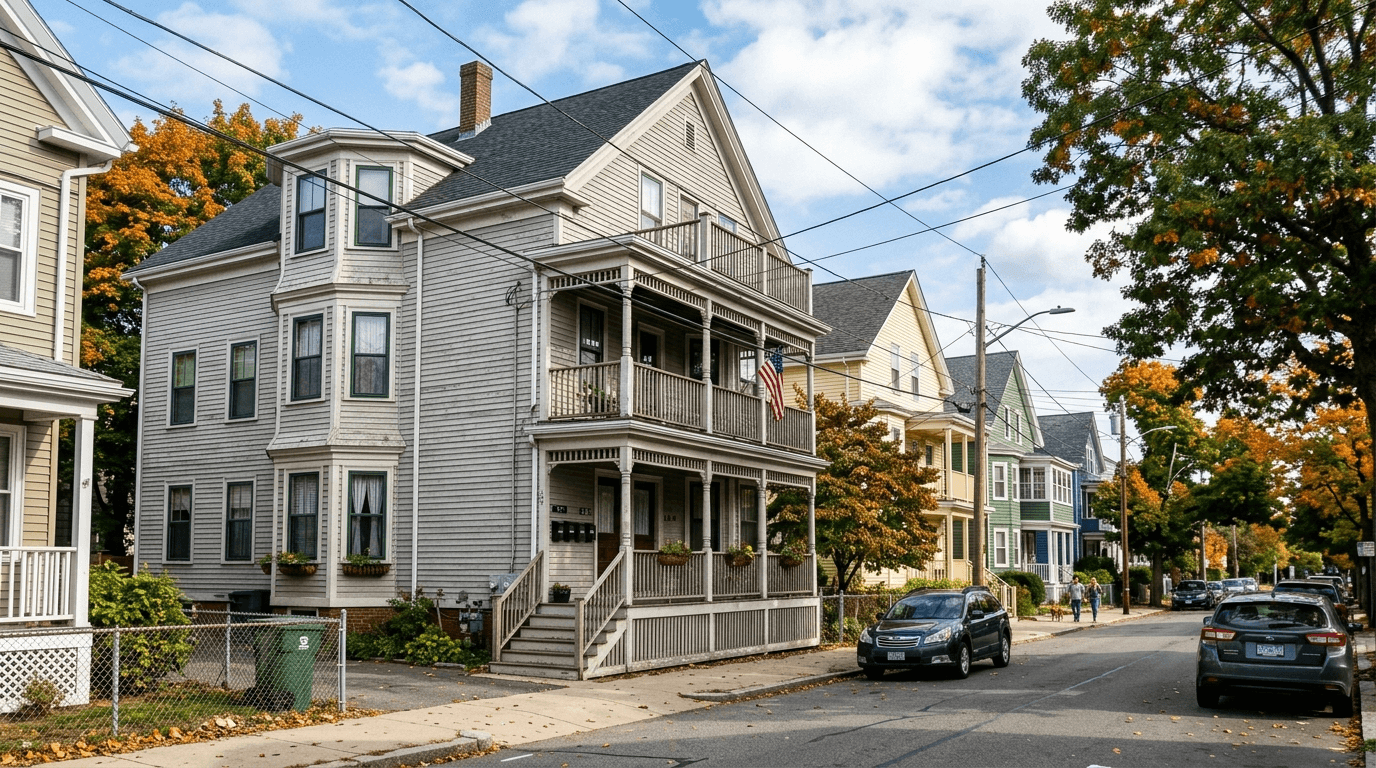
The same vacancy increase handing renters more choices is also squeezing small landlords. Owners of older triple-deckers are now competing against brand-new buildings that are actively dangling deals to fill units.
As of mid-2026, renters have real bargaining power in Boston's rental market for the first time in years, per Boston Pads' market reporting cited below. The for-sale side, meanwhile, is telling a different story — single-family homes are still moving in a median of 17 days, while condos are sitting.
Thousands of new apartments have opened across the Seaport, Fenway, and the Dorchester Avenue corridor. Vacancy is rising. Concessions are back. Renters are seeing offers like one free month of rent or a paid broker fee just to sign a lease.
For small landlords, though, the Sept. 1 lease turnover is bearing down fast. Wait too long, and you risk carrying a vacant unit into the fall.
In Boston, that gets expensive quickly.
What Does the Boston Multifamily Delivery Wave Actually Mean Right Now?
For most of the last decade, Boston simply didn't build enough housing. Rents climbed. Vacancy stayed low. Renters had almost no leverage.
Then the projects approved during the low-rate years of 2021–2023 started opening simultaneously — arriving into a market with higher interest rates and slower renter demand. That has shifted the balance.
New Class A buildings — brand-new, amenity-heavy apartment complexes — are offering one to two months of free rent to fill units, per Boston Pads market reporting. That puts direct pressure on the older triple-decker down the street.
The vacancy data makes the shift concrete. Per Boston Pads' real-time tracker, vacancy sits at 1.43% today. In absolute terms, that's still a landlord-friendly number by national benchmarks. But the story here is the swing, not the level. Vacancy is up +72.29% from a year ago and has more than doubled since April 2024. The tracker projects vacancy will reach a 3% threshold by Sept. 2, 2026.
Boston Rental Vacancy Pulse
Rental vacancy metrics from Boston Pads showing current RTVR, recent comparisons, and the stated 2026 target threshold.
Current Vacancy
Real-Time Vacancy Rate (RTVR) — currently1.43%
Change
RTVR change from a year ago+72.29%
RTVR change compared to April 2024+104.29%
Recent Range
Vacancy bottomed out (last year, late August)0.74%
Vacancy climaxed (last year, early September)1.85%
Boston's rental calendar revolves around Sept. 1 — the long-standing local lease-turnover convention tracked by Boston Pads. A unit that misses that window and sits empty into October can be extremely difficult to fill before January. For landlords, that means months of lost rent. For renters, it means this summer is a rare window to negotiate.
How Tight Is the For-Sale Market Compared to Rentals?
The rental market is softening. The for-sale market is more complicated.
Single-family homes are still moving quickly. Condos are taking longer and carrying far more supply. Single-family homes show 11.0 months of supply, while condo inventory sits at 21.5 months — meaning at the current sales pace, it would take nearly two years to sell every condo currently listed.
The speed gap is real too. The median time from listing to sale for single-family homes is 17 days, with a median sold price of $842,000. Condos take longer, with a median of 24 days and a median sold price of $1,060,000.
Boston For-Sale Market Snapshot: Supply, Speed, and Prices
Primary MLS/Repliers snapshot of Boston’s active inventory and last-180-day single-family and condo market conditions.
For a triple-decker owner, this split matters — and it complicates the instinct to just sell.
An owner-occupant buyer, someone who wants to live in one unit and rent out the others, may still be active for a 2–4 unit property. But pure investors are more cautious. They need a higher return because financing is more expensive and rents are less certain, which pushes their offer price down. And if a triple-decker is being sold as a condo conversion, it lands squarely in the most oversupplied segment of the for-sale market.
Where Is the Squeeze Sharpest by Neighborhood?
The pressure isn't landing evenly across Boston.
The table below is an editorial synthesis based on Boston Pads neighborhood rent and delivery data, combined with publicly reported project openings.
Neighborhood Pressure on Boston Triple-Decker Owners
Compares current rental-market conditions and pressure levels for triple-decker owners across Boston neighborhoods ahead of the Fall 2026 leasing season.
Category
What's Happening
Pressure on Triple-Decker Owners
Dorchester & Mattapan
New Dorchester Ave mid-rises with gyms and in-unit laundry
East Boston is under high pressure. Waterfront deliveries at Suffolk Downs and Clippership Wharf are pulling renters toward new product. Dorchester and Mattapan are also under high pressure — new Dorchester Avenue mid-rises with gyms and in-unit laundry are competing directly with older three-families. South Boston is holding firmer, with low pressure. Jamaica Plain and Roslindale show asking rents that are flat compared to a year ago, with medium pressure.
Location still matters. Per WalkScore.com as reported in 2026, Boston's citywide Walk Score is 82.8, and that keeps older triple-deckers relevant. Many renters still want walkable streets, neighborhood restaurants, transit access, and homes with character.
But character alone isn't always enough.
Many older units lack in-unit laundry and central air — two features that can pull renters toward newer buildings, especially when those buildings are also offering free rent. Neighborhood rents are starting to split as a result. A renovated, well-located triple-decker may still perform well. An older unit with no updates may need a concession to compete.
What Is the Repositioning Playbook Small Landlords Are Running?
Small landlords have five realistic moves this summer. None is universally right. The correct choice depends on debt level, unit condition, and your read on the November rent control ballot.
What If You Offer Concessions Instead of Cutting Rent?
This is often the first move. A landlord might offer a half-month free or cover the broker fee instead of lowering the monthly rent. That keeps the headline rent — the number on the lease — higher, which matters for refinancing and resale value.
One honest note: lenders and buyers are already discounting Boston rent growth assumptions because of regulatory risk. So the refinancing benefit of preserving headline rent is real, but partial.
For renters, the takeaway is clear: ask for real savings upfront. A free month is worth roughly 8.3% of annual rent — far more valuable than a small monthly cut. On a hypothetical $2,400/month unit, one free month equals $2,400. Spread across 12 months, that's $200/month in effective savings. That's the number renters should use when comparing a free-month offer to a modest monthly discount.
What If You Do a Light Renovation?
Some owners are spending a five-figure sum per unit on targeted upgrades — typically in-unit laundry, quartz counters, and mini-split AC. The goal isn't to turn a triple-decker into a luxury tower. The goal is to stay competitive enough that a renter doesn't choose a Class A studio instead.
Be realistic about the ceiling. A renovated triple-decker can compete on price and character, but it can't match a brand-new building's amenities and a free-month giveaway simultaneously. The play is to be a clear second choice at a meaningfully lower rent — not to out-Class-A the Class A buildings.
The key question for landlords is straightforward: will the upgrade cost less than months of vacancy?
What If You Refinance Now?
Some owners may want to refinance before more uncertainty arrives. The November ballot vote on statewide rent control is one reason. If a property's value depends on future rent growth, any new rent limits could affect how lenders and buyers price that building. For landlords, this is about managing risk before the market becomes harder to underwrite.
What If You Sell to an Owner-Occupant?
This may be the strongest exit for some small landlords — but it's harder than it looks.
A house-hacker buyer lives in one unit and rents out the others. FHA program rules allow a low down payment on a 2–4 unit owner-occupied property (see HUD's FHA single-family handbook for current minimums), which can make a triple-decker more accessible to that buyer. It also creates a cleaner sale path than targeting pure investors — and a far cleaner path than trying to sell as condos into a market with 21.5 months of supply.
One honest tension worth naming: if small landlords sell in bulk to institutional investors rather than owner-occupants, Boston loses naturally affordable rental stock. Selling to an owner-occupant is the version of this exit that does the least damage to the city's housing supply.
What If You Hold and Wait?
This can work for owners with low debt or no mortgage. If the property is paid off, the owner may be able to ride out 18–24 months of softer rents. Norada's regional forecast puts Boston at only -1.6% by June 2026 — a modest dip, not a collapse.
The wait may be tolerable for a specific reason: the 2027–2028 delivery pipeline thins out sharply because permits ran below trend in 2024–2025. If you can afford to wait, the market may shift back in your favor.
But holding still requires a plan. A vacant or outdated unit isn't passive income. It's a monthly cost.
What Are the Strongest Arguments Against This Framing?
Not every triple-decker owner is under the same pressure. Here are the three strongest objections — and the practical answer to each.
Can Paid-Off Triple-Decker Owners Just Ride It Out?
Largely, yes — and this article should say so plainly.
An owner with no mortgage doesn't face the same refinancing pressure. The "passive ownership is the riskiest play" framing applies most directly to leveraged owners with floating-rate or near-maturity debt.
That said, even debt-free owners face real carrying costs: rising insurance, taxes, repairs, and utilities. In a softer rental market, pushing rent too hard to cover those costs can trigger a move-out — and a vacant unit through October is expensive regardless of your debt position.
The honest decision rule: a debt-free owner can wait. A leveraged owner with a refinance coming due in the next 12–18 months probably can't.
Should Small Landlords Just Sell Now Into Tight Inventory?
On the surface, this looks like a seller's window. Recent single-family medians have been reported in the $842K–$857K range depending on source and month; this article uses the $842,000 figure from MLSPIN via Repliers. With only 11.0 months of single-family supply, that does read like a tight market.
But triple-deckers don't price like single-family homes.
Small multifamily buyers are almost always investors. They set prices based on what a building can earn in rent — not on what nearby single-family houses are selling for (what agents call "comps," short for comparable sales). With rents softening and expenses rising, investor offers are getting discounted. That's a fundamentally different dynamic from a single-family buyer who may pay a premium simply because they want the home.
There's also a broader price trajectory to consider. Norada's regional forecast puts Boston at -1.6% by June 2026, Springfield at -0.6%, Worcester at 0.1%, and Pittsfield at 0.9%. The smaller-market figures provide regional context for the Boston number.
The chart also shows the trajectory leading into that June 2026 endpoint — a gradual softening that deepens from July 2025 through September 2025 and into June 2026, not a sudden drop.
In plain terms: waiting 12–18 months for the supply wave to get absorbed may not hurt as much as it would in a fast-rising market. Selling is a valid choice, but it's far from an obvious one.
Would Rent Control Make Renovations a Bad Bet?
This is the hardest question, and it calls for a clear decision rule rather than two contradicting signals.
The regulatory risk is real. Worcester Mayor Joseph M. Petty has called the proposed statewide ballot question "the most restrictive statewide policy in the country," citing experience in St. Paul, Minnesota and Montgomery County, Maryland (per his public statements and reporting on those jurisdictions; the underlying St. Paul figures have been examined in University of Minnesota research, and Montgomery County permit volumes are tracked by the county's permitting office).
A practical decision rule for landlords:
•If you believe rent control passes in November: prioritize refinancing now, defer major renovation spend, and keep capital flexible. New rent ceilings would cap your ability to earn back a renovation.
•If you believe rent control fails: renovation ROI improves, because you can reset rents on turnover and recapture upgrade costs.
•If you're unsure: smaller, faster-payback upgrades — in-unit laundry, mini-splits — beat large gut renovations, because they pay back inside the political risk window.
A clean, updated unit that leases quickly is generally safer than an outdated unit sitting vacant. But the size of the renovation bet should scale to your read on the ballot.
What Does the Delivery Wave Mean for Renters?
For renters, the short-term answer is genuinely positive.
If you're signing a lease this summer or early fall, you have more bargaining power than Boston renters have had in years. That doesn't mean every landlord will cut rent — but it does mean you should ask.
Focus on concessions, not just the monthly number. One free month on a 12-month lease is worth roughly 8.3% of annual rent. On a $2,400/month unit, that's $2,400 upfront, or about $200/month in effective savings spread across the lease. That's the right benchmark when weighing a free-month offer against a small monthly rent reduction.
Ask about broker-fee coverage too. In Boston, that can be a significant out-of-pocket cost. And don't overlook the inner-ring suburbs — Quincy, Malden, and Medford are also softening as Boston deals become more competitive again.
Renters should also watch the longer-term risk, though. If small landlords sell in large numbers to bulk investors, or if older rentals convert to condos, Boston could lose a meaningful share of its naturally affordable rental stock. Older triple-decker units typically rent well below new Class A asking rents. A renter-friendly moment can quietly become a longer-term shortage if too much of that older housing disappears.
What Should Small Landlords, Renters, and Buyers Watch Before Fall 2026?
Three deadlines are converging. The table below pulls from publicly available sources: the November 2026 ballot date is set by the Massachusetts Secretary of the Commonwealth; the Sept. 1 lease turnover follows the long-standing Boston convention tracked by Boston Pads; and the projected 3% vacancy threshold comes from the Boston Pads real-time vacancy tracker.
Fall 2026 Boston Small Landlord Decision Deadlines
Lists key Fall 2026 deadlines affecting Boston triple-decker owners, including lease turnover, the rent control ballot vote, and refinancing timing.
Category
What Happens
Sept 1, 2026
Boston lease turnover concentrates here
Nov 3, 2026
Massachusetts statewide rent control ballot vote
Q4 2026
Last clean refinancing window before 2027 rate decisions
For renters: negotiate this summer. Ask for concessions, compare new buildings against older units, and don't treat the asking rent as final.
For leveraged small landlords: don't drift into September without a plan. Decide whether you're offering concessions, upgrading, refinancing, selling, or holding — and tie that decision to your debt load and your read on the ballot.
For debt-free owners: you have the option to wait. A modest forecast price dip and a thinning 2027–2028 pipeline make holding a defensible choice — as long as the unit is rentable and you have a turnover plan in place.
For buyers eyeing a triple-decker: this may be the first real opening in years. A 2–4 unit owner-occupied property can still pencil out, especially with FHA financing. See HUD/FHA program rules for current down payment minimums. But the deal has to be built on realistic rents, not peak-market assumptions.
Boston's delivery wave isn't the end of the triple-decker landlord. It's the end of drifting.
The owners who thrive in 2027 are the ones making clear decisions now — including the clear decision to hold. If you want to understand what this means for a specific Boston neighborhood or a specific triple-decker, ask for a neighborhood rent and resale review before the Sept. 1 window closes.
Common Questions
What does Boston’s multifamily delivery wave mean for renters in 2026?
Renters have more leverage because thousands of new apartments have opened across Seaport, Fenway, and the Dorchester Avenue corridor. In the Boston housing market, vacancy is rising and Class A buildings are offering concessions like one or two free months, which puts pressure on older apartments to compete.
How are triple-decker landlords being squeezed right now?
Triple-decker landlords are squeezed because newer rentals are offering perks that older three-families often lack, such as in-unit laundry and central air. With Sept. 1 turnover close, owners must choose between concessions, renovations, refinancing, selling, or holding through a softer Boston real estate market.
What Boston neighborhoods are most affected by the rental supply wave?
Neighborhood rents are splitting, not moving the same way everywhere. The article says East Boston and Dorchester deliveries are pulling demand from older three-families, while South Boston and parts of Jamaica Plain are holding firmer. Walkable locations still help older Boston rentals stay relevant.
Is selling a Boston triple-decker better than renting it out right now?
Selling can work, especially to an owner-occupant buyer who wants to live in one unit and rent the others. But the draft says pure investors are thinner and demand higher returns, which can lower prices. For many triple-decker landlords, selling is viable but not automatically best.
Can small landlords avoid cutting rent in Boston this summer?
Small landlords can avoid a headline rent cut by offering concessions instead, such as a half-month free or paying the broker fee. The article says this can help keep the stated rent intact for refinancing and appraisal while still meeting renters’ stronger bargaining position in the Boston housing market.
What happens if a Boston rental is still vacant after Sept. 1?
Vacancy after Sept. 1 can be costly because Boston’s rental calendar is heavily tied to that turnover date. The article says units that sit empty into October often remain vacant until January. That is why unrenovated triple-decker units face a tighter decision window this summer.