
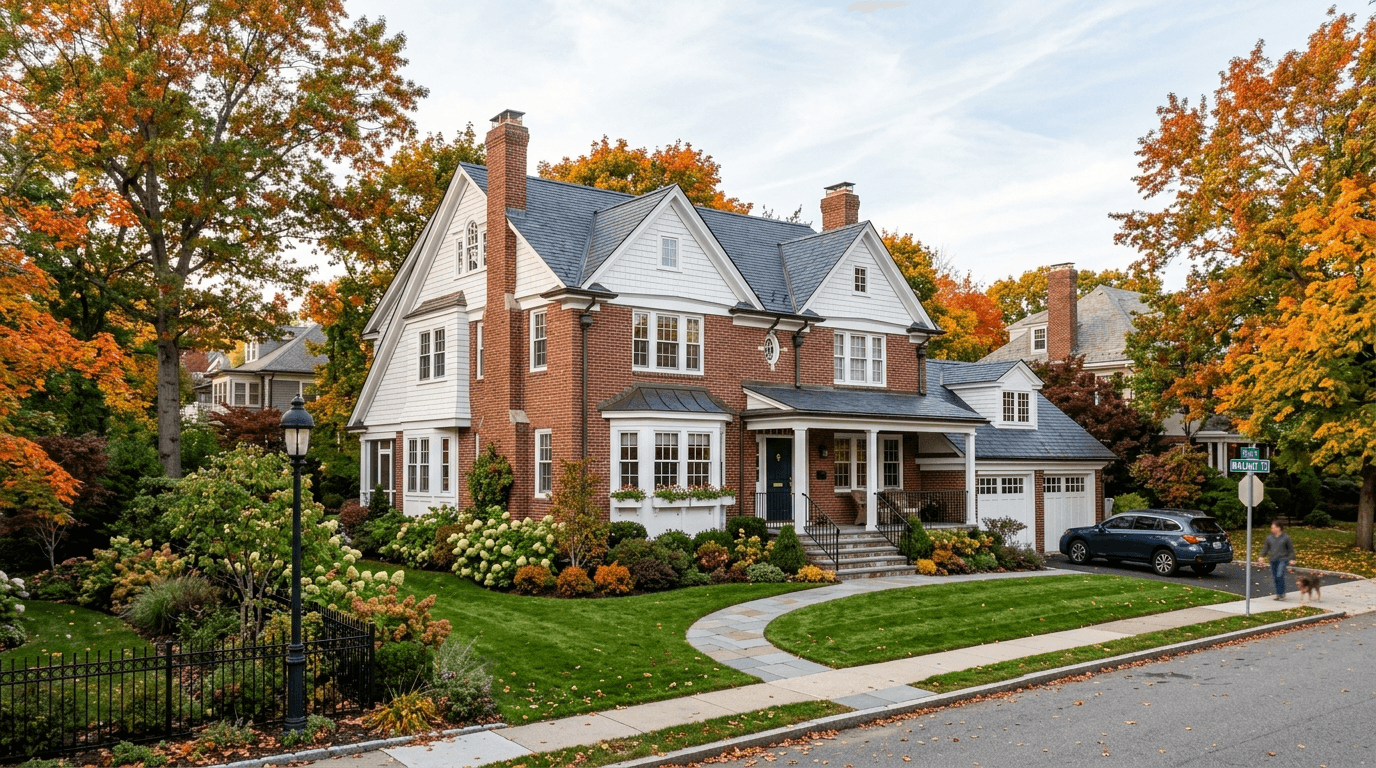
Key Takeaways
•The bottom line: Brookline single-family homes are averaging $3.04M in 2026, barely above the $3.01M they averaged a year ago (+0.8%), per the Gibson Sotheby's Brookline market report. Price to today, not to 2021.
•The proof: Houses now take 51 days to get an offer and sell at 99.09% of current list (but only 97.58% of original list), per Gibson Sotheby's. Overpricing tends to add days, not dollars.
•The trap: Condos are moving fast, but single-family homes are a slower, separate segment. Don't price your house off a condo comp — or your neighbor's list price.
•The move: Anchor to a comparative market analysis (a study of recent closed single-family sales), set a price you'd happily accept in about 50 days, and prepare the home.
# What Does Brookline's $3.04M Single-Family Number Mean If You're Selling This Fall?
Most Brookline sellers still remember 2021: list high, wait for offers, sell over asking in a weekend. If you're listing your single-family home this fall, that old playbook can cost you money. It's late August 2026, the fall market is opening now, and the latest single-family data shows growth has largely flattened.
Brookline single-family homes averaged $3.04M across 48 closed sales so far this year — barely above the $3.01M from a year earlier, a gain of just 0.8%. The figures come from the Gibson Sotheby's Brookline market report by Joe Wolvek, as of June 2, 2026. For sellers, the $3.04M level is more of a ceiling than a launchpad.
Why Should You Price To Today Instead Of Last Year?
In a flatter market, your first price matters more. A strong day-one price brings serious buyers in quickly. An ambitious price that gets cut later sends the wrong message — buyers notice cuts, wonder what's wrong, and negotiate harder.
The most common worry is simple: "Am I leaving money on the table if I don't push the price?"
The evidence leans toward caution. In 2026, Brookline single-family homes closed at 99.09% of their current list price, but only 97.58% of their original list price, per Gibson Sotheby's. That gap doesn't prove a higher initial price never nets more, but it does show that many sellers who started high had to walk the price down. The higher first number bought delay, not value.
Supply backs this up. Months of supply rose to 6.7 months, up from 5.3 a year ago — a measure of how long it would take to sell every listed home at today's pace. Anything above 6 months starts to favor buyers.
Two more signals agree. The typical Brookline house took 51 days to get an accepted offer, up from 40 a year earlier. And homes with price cuts more than doubled, to 45 in 2026 from 22 the year before.
Single-family and condo segments differ sharply on the metrics that drive your pricing decision, as the chart below shows for the broader housing stock.
Single-Family Detached Homes Are a Small Share of Brookline Housing
A part-to-whole view of Brookline’s housing stock showing the limited share of single-family detached units.
TOTAL
Single-family detached share
~18%
Other housing types
~82%
| Series | Label | Value |
|---|---|---|
| Housing stock share | Single-family detached share | ~18% |
| Housing stock share | Other housing types | ~82% |
Source:Brookline 2050
For your wallet, the takeaway is direct: overpricing isn't being rewarded here. It's being corrected.
What If Your Neighbor Got Over Asking?
You may hear stories about Brookline homes selling in days with multiple offers. Some are true. But many are about condos — a different market entirely.
Single-family detached homes make up roughly 18% of the housing stock, per Brookline 2050 data covering Brookline and Weston. That scarcity keeps the segment expensive, but it isn't holding prices up right now, because demand at the top has softened — which is exactly why supply has climbed and cuts have doubled.
Condos are moving faster: 3.2 months of supply, 100.4% of list, and about 35 days to an offer. Single-family homes show 6.7 months of supply and 51 days, per Gibson Sotheby's. Don't price a single-family home off a condo comp, and don't price off your neighbor's list price. A list price is a wish. A closed sale is evidence.
This isn't a crash. Price per square foot for single-family homes rose 5.5% to $835, per Gibson Sotheby's. So why is the overall average nearly flat? It's largely a mix effect: fewer large, high-priced homes are closing, which pulls the average down even as per-square-foot value climbs. A buyer-favoring supply level means buyers are choosier — a well-priced home can still draw demand while an overpriced one sits.
That's why the wrong anchor hurts. Active single-family listings ask an average of $4,994,790, far above the $3.04M actually closing, per Gibson Sotheby's. That gap mostly reflects larger, higher-end homes lingering on the market, so anchor your budget to closed sales like yours, not to active asking prices.
Are Well-Priced Homes Still Getting Bids?
Yes. A careful price isn't a weak price. It's a price that creates confidence.
Across Norfolk County in July 2026, the typical home sold for 101.8% of list — 1.8% above asking — and the share selling above asking rose 1.6 points year over year, per Redfin's Norfolk County July 2026 report. That's a broader-region figure, not specific to Brookline single-family homes, which are running closer to full ask. But Redfin's read still applies: "accurate initial pricing still generated bidding wars." Buyers compete for the right home at the right price. They're less willing to chase homes that start too high.
Your best comp isn't a condo sale, a neighbor's asking price, a 2021 result, or a home of different size or condition. It's a recent, similar, closed single-family sale.
What Are The Strongest Arguments Against This?
There are fair objections.
"Only 48 sales is a small sample — one or two $10M trophy sales could inflate the average."
Fair. A few high-end sales can distort an average. But distortion-resistant metrics tell the same story. Price per square foot, which normalizes for size, still rose only modestly. And days on market don't depend on average price level at all. Independent Q2 2026 data from the Steinmetz Real Estate team at William Raveis, as of June 10, 2026, showed single-family homes at a 100% sale-to-list ratio (the final price as a percentage of asking) and 52 median days on market — the typical time a home is listed before going under agreement. Both sources roughly agree: Brookline houses are clearing near asking, not far above it, and not instantly. That's not a trophy-sale artifact.
"Another brokerage says Brookline is still hot — a median around $1.87M, up 5.2%, a 103.7% list-to-sale ratio, and just 1.4 months of inventory."
Those numbers most sharply contradict a flat read, so they deserve a direct answer. A 103.7% list-to-sale ratio — homes selling 3.7% above asking — and 1.4 months of supply describe a fierce seller's market. But they almost certainly reflect a different property mix and an earlier window, likely blending condos and lower-priced homes. For a fall single-family decision, lean on current, local closed sales instead. Those show a sale-to-list ratio near 100%, days on market in the low 50s, and 6.7 months of single-family supply — not the 1.4-month, over-asking picture the rival figures suggest.
The smart move isn't picking the most flattering headline. It's building a current comparative market analysis (CMA) — a study of recent closed sales truly similar to your home — for your exact address.
How Should You Price Your Brookline Home This Fall?
Early fall can be a strong time to list. The buyer pool stays steady thanks to the Longwood Medical Area, universities, hospitals, and families settling before winter. But demand isn't unlimited.
Your pricing rule this fall should be simple:
•Anchor to a CMA built on recent closed single-family comps — not list prices, not condos.
•Target a number you'd happily accept within about 50 days, reflecting the current pace to an offer.
•Don't "test" a higher price. Testing high usually adds days and invites a cut.
Preparation matters too. When buyers have more choices, condition counts. Stale paint, tired lighting, clutter, and deferred repairs all become negotiating points. A well-prepared home lets buyers focus on value, not flaws.
What Seller Costs Should You Plan For?
If you're not a Massachusetts full-time resident, ask your attorney early whether any non-resident withholding applies to your sale, since state tax rules can change.
Also budget for standard Brookline seller costs:
•Massachusetts deeds excise at $4.56 per $1,000 of sale price, per Mass.gov
•Your attorney's fee
•Smoke and carbon monoxide certificate
•Municipal lien certificate
•Prorated property taxes
These costs don't change the pricing strategy, but they do affect your net proceeds. Know that number before offers arrive.
What Is The Bottom Line For Brookline Fall Sellers?
The $3.04M single-family number is a warning against overconfidence, not a sign of weakness. Buyers are simply more disciplined. You can still sell well this fall — but price to the market you're in now, not the one you remember from 2021. Price near the evidence, prepare the home, and aim to sell at or near asking in roughly 50 days. Aim far above the ceiling, and you risk becoming the listing that sits.
To see what this means for your block, request a current CMA for your address before you choose a fall list price.