
Key Takeaways
•The headline answer: Greater Boston has seen a major wave of new multifamily supply in the past 12 months — one of the largest in a generation — but absorption depends less on demand and more on whether the MBTA and roads can carry the new riders.
•The policy engine — with a caveat: The MBTA Communities Act is working at the zoning step, forcing as-of-right multifamily zoning near transit. But the Act is one policy lever; transit infrastructure investment is a separate lever, and the two are not moving at the same speed.
•The compliance gap: We do not have municipal-by-municipal compliance data for the Act in June 2026. That means we cannot fully attribute the current supply wave to the Act alone, and we are flagging that uncertainty upfront rather than burying it.
•The hidden ceiling: Boston-area congestion is among the worst in the country, and MBTA capacity is shrinking in the short term as stations close for rebuilds.
•Who this is really for: The "underwrite the line, not the listing" framework applies most to peak-hour commuters. Cash buyers, downsizers, and remote/hybrid workers face a different — and often simpler — version of this decision.
•The thesis, honestly stated: For peak-hour commuters, this is a preserve-value play more than a capture-opportunity play. The best transit-rich locations will likely stay expensive. The opportunity, where it exists, is in concessions on new rentals and softer pricing in weaker-transit submarkets — both of which come with trade-offs.
The promise of transit-oriented development only pays off if the transit actually works. In Greater Boston in 2026, that is still an open question.
What Just Changed in the Greater Boston Housing Market?
For years, the Greater Boston story felt stuck. Not enough homes. Too much local red tape. Rents that climbed every spring like clockwork.
In June 2026, that story is finally shifting — at least on the supply side.
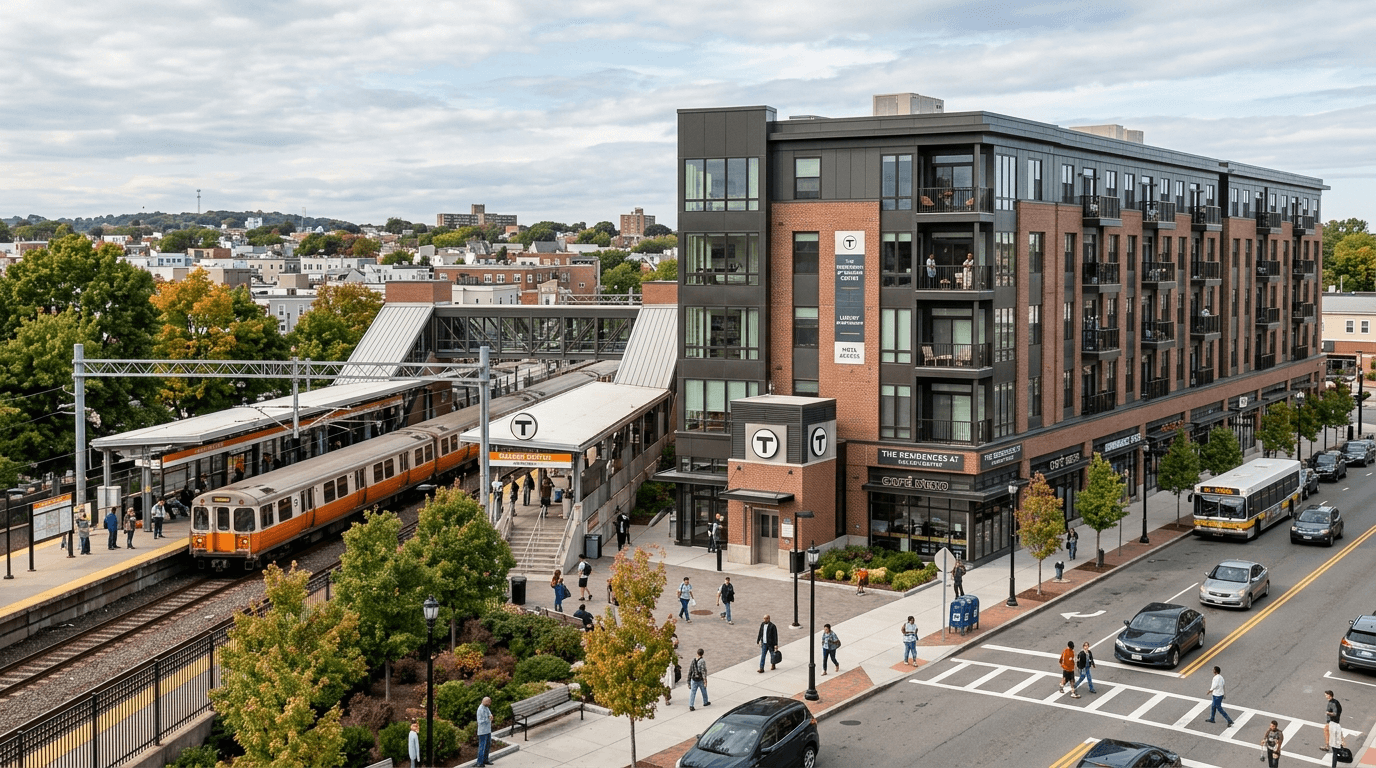
Greater Boston has delivered a large wave of new multifamily units over the past 12 months. Much of it traces back to projects approved in 2022 and 2023, after the MBTA Communities Act started pushing cities and towns to allow more housing near transit.
The market is responding. Rent growth in the metro slowed to 1.1% year over year in the third quarter of 2025, down from 2.1% the prior quarter. Vacancy rose to 6.3%, up 70 basis points (0.7 percentage points).
The snapshot below puts those rent and vacancy figures in context.
Greater Boston Multifamily Cooling Signals, Q3 2025
Headline market card showing Greater Boston multifamily rent-growth deceleration alongside elevated vacancy.
Colliers Q3 2025 Multifamily Report
Report periodQ3 2025
Rent Growth
Rent growth (year-over-year), prior2.1%
Rent growth (year-over-year), third quarter1.1%
Vacancy
Vacancy rate6.3%
Vacancy rate change70 basis points
This is what real-time absorption looks like. More units are opening. Rent growth is cooling. More apartments are sitting available.
For renters, that can translate to real negotiating power. Market reports this year have described new Class A buildings — the newest, higher-end rentals — offering meaningful concessions to fill units.
One important caveat on those concessions: A first-year discount is not the same as long-term affordability. If a building offers one month free on a 12-month lease, your effective rent in year one drops by roughly the value of one month spread across twelve — about 8%. But if year two resets to the full asking rent, or higher, your two-year average lands much closer to the sticker price. Treat concessions as a one-time discount, not a structural change in what the unit actually costs.
Bottom line: The supply wave is real, and it is softening parts of the rental market. But the relief is uneven across neighborhoods, and it may not survive past the first lease cycle.
How Did Greater Boston Get This Wave of New Supply?
For much of the 2010s, Massachusetts made it genuinely hard to build. Local zoning rules were tight. Permitting took time. Small delays compounded. When projects get harder to approve, fewer get built.
The MBTA Communities Act changed the math. It requires many cities and towns served by the T to allow multifamily zoning by right near transit. "By right" means a builder does not need a special town vote for every qualifying project.
That lowers uncertainty. It does not make building easy. But it makes building possible in places where it was routinely blocked before.
Honest caveat on causation: We do not have municipal-by-municipal compliance data for the Act as of June 2026. We cannot tell you what share of covered communities are fully in compliance today. That means we cannot cleanly attribute the current supply wave to the Act alone — some of these projects were already in the pipeline before the Act's deadlines took hold, and local approval patterns vary widely. The Act is plausibly a major driver. It is not the only one.
Is Comparing Greater Boston to California's SB 79 Apples-to-Oranges?
Largely, yes — and it is worth being careful here.
California's SB 79, which has received significant coverage in housing policy circles, is a much larger and more aggressive intervention than the MBTA Communities Act. It overrides local zoning more directly than Massachusetts has attempted.
Leaning on SB 79 as a validating parallel would be misleading, because it is not one. The narrow, practical lesson from the California experience is this: even aggressive state-level housing laws face local pushback, delay tactics, and creative workarounds. Massachusetts should expect the same friction, at its own scale.
The practical takeaway is straightforward: do not assume every town near the T will add supply at the same speed. Local politics still shape local inventory.
What Is the Capacity Ceiling Nobody Priced In?
Here is the part buyers, renters, and investors should not overlook: housing supply is rising, but the transportation system serving that new supply is still strained.
That is the real capacity ceiling — and it is a separate policy problem from zoning. The MBTA Communities Act addresses where housing can be built. It does not address whether the trains and buses serving that housing can carry more riders. Those are two different levers, and conflating them is exactly how transit-oriented development gets oversold.
In June 2026, the MBTA closed Symphony Station on the Green Line for a multi-year rebuild. That one closure does not define the whole system. But it signals that an aging transit network cannot absorb thousands of new households without pain, delays, and service disruption. Riders should consult MBTA announcements for the current closure timeline and reopening estimate.
Then add Boston-area traffic. Congestion around Greater Boston remains among the worst in the country. "Near transit" only works when the transit is reliable.
When the train is delayed, the bus is slow, or the road backup is constant, the value of that location changes. A "T-stop premium" can start to feel like a "T-stop tax" on your time.
A home or apartment near a weak transit line may not hold value the same way as one near a reliable line. The address may look similar on a map. The daily experience can be very different.
Where Does the New Supply Actually Land?
Not every new unit carries the same value. A half-mile from transit sounds compelling in a listing. The details matter more.
Ask these questions before you commit:
•Which line serves the property?
•How often does it run?
•Is the station under repair?
•Are there known shutdowns or slow zones?
•Can you still get to work if the line has a bad morning?
The table below summarizes how different submarket types compare on commute reliability, drawn from a synthesis of MBTA published service frequencies and broker market commentary on transit-adjacent supply. Treat it as a framework, not a precise ranking.
Greater Boston Submarket Transit-Oriented Housing Read
Compares buyer and renter implications across Massachusetts submarket types based on transit reliability and disruption risks in the June 2026 Greater Boston multifamily supply wave.
| Category | Transit Reality | Buyer/Renter Read |
|---|---|---|
| Winners (Malden, Quincy, Medford near GLX, Salem) | Frequent rail + new MBTA Communities zoning | Buy/hold with confidence |
| Mixed Bag (Outer 128/495 towns) | Commuter rail every 60–90 minutes | "Transit" oversells the daily reality |
| Caution Zones (Green Line E/B branches, Symphony radius) | 3+ years of construction disruption | Expect concessions; verify timeline |
| Outside the story (Western/Central MA) | Different market entirely | The 12,410-unit wave doesn't reach you |
Source: Synthesis of MBTA published service-frequency data and Colliers Greater Boston market commentary, 2025.
Bottom line: "Transit-adjacent" is not a single category. It is a spectrum. Frequent-rail submarkets behave very differently from commuter-rail-only towns, where service may run far less often during off-peak hours. Areas facing multi-year station construction are a third, more cautious category entirely.
That difference shows up in rent, resale value, and quality of life — sometimes dramatically.
What Are the Strongest Arguments Against This Concern?
It is a fair question: is the capacity concern overblown? Here are the strongest objections.
Is Transit Capacity Really a Long-Term Problem, Not a Short-Term Leasing Problem?
Partly, yes.
In the short run, brand-new buildings near working stations often lease up without much trouble. A new apartment next to a solid Red Line stop will attract renters.
The next phase is where it gets complicated. Renters compare buildings on price, commute time, concessions, amenities, and reliability. The newest buildings with the best transit access may still perform well. Older transit-adjacent buildings will likely feel more pressure.
So the supply wave can get absorbed. The sharper question is: which buildings have to cut prices or offer concessions to get there? That is the line between stable value and soft value.
Does Traffic Really Matter If Renters Near Transit Own Fewer Cars?
More than it seems.
Many renters near transit drive less. For a single renter, the morning train may matter far more than the regional traffic map. But congestion does not stop at the driver's seat. Traffic slows buses. It weakens last-mile connections. It makes cross-town trips harder and shrinks the job options that feel realistic from a given apartment.
That affects lifestyle. It also affects rent support. People pay more for convenience. When the commute becomes unreliable, the premium gets harder to justify.
Who Does This Calculus Not Apply To?
The transit-selection framework in this article is built for peak-hour commuters who need the T to work five days a week. Several other groups face a simpler version of this decision, and that distinction is worth stating clearly rather than implying the framework applies to everyone.
Are Cash Buyers and Downsizers Less Exposed?
Yes. If you are not commuting at peak hours, this supply wave is more opportunity than risk. You may benefit from softer pricing or better concessions without caring much about the morning rush.
Are Remote and Hybrid Workers in a Better Position?
Often. If you go into the office two days a week or less, a transit hiccup is an annoyance, not a life-altering problem. You have more flexibility to choose value over perfect access — and for you, that trade-off may favor a less premium-priced location.
Do Single-Family Buyers Need to Read This Differently?
Yes. The surge is mostly multifamily. It does not directly create a large number of detached single-family homes. Single-family supply remains tight across much of the region. If you are shopping for a house, your market may still feel competitive.
Are Western and Central Massachusetts Playing by Different Rules?
Yes. Springfield, Worcester, and the Pioneer Valley have different supply-demand dynamics than inner Greater Boston. Transit access still matters there. But the MBTA-driven zoning story does not translate the same way outside the Boston orbit.
What Should Greater Boston Homebuyers and Renters Actually Do?
If you are buying or renting in Greater Boston right now, stop asking "Is this near transit?" and start asking better questions.
How Should You Evaluate the Transit Line?
Start with the line, not the logo. A Green Line branch address is not the same as a Red Line address. A commuter rail stop is not the same as a frequent subway stop. The listing may say "near the T." Your commute may tell a different story.
Should You Read the MBTA Capital Plan?
Yes. Before paying a premium for transit access, check whether the nearby station or line is scheduled for major work. Is it receiving investment, or is it next in line for disruption? That can affect both daily life and the long-term value of the location.
Can You Use Today's Concession Window Without Getting Trapped?
You can — but read the renewal terms before you sign. A first-year free month only translates to lasting affordability if year-two rent does not snap back hard. Ask the landlord in writing:
•What is the renewal rent likely to be?
•Is there a cap on year-two increases?
•What is the asking rent on identical units leased without concessions?
That last question reveals the true market rent of the unit — which is almost certainly what you will face at renewal.
Should Walkability and Schools Still Matter?
Yes. Towns with strong schools and high walkability tend to hold value better, especially when transit service is uneven. If the train is delayed, it still helps to live near shops, parks, schools, and daily errands.
Why Does Assessed Value vs. Market Value Matter — and Why Is It a Real Cost?
Plain version: assessed value is the number your town uses to calculate your property tax bill. Market value is what a buyer would actually pay for the home today.
New supply can pressure market value faster than it changes assessments. That means property taxes can feel high relative to a softening sale price — and this is not just a buyer-beware footnote. It is a real cost that partially offsets the affordability gains a softer market is supposed to deliver.
If you are buying a condo in a submarket with heavy new inventory, model your property tax as if the assessment lags reality for a year or two. The headline price discount may be smaller than it appears once carrying costs are included.
Will Supply Actually Fix Affordability — or Just Move the Squeeze?
Supply helps. Supply alone does not solve everything. Three paths forward are plausible, and we are assigning rough probability weights so these scenarios are not presented as equally likely.
Best Case — roughly 20–25% likely
From 2027 to 2029, the state pairs the MBTA Communities Act buildout with serious reinvestment in the T. Closures like Symphony Station become part of a larger repair plan that finishes on schedule. The region handles more housing because the transit system gets stronger over time. Cleanest win for buyers, renters, employers, and towns alike.
Base Case — roughly 50–60% likely
Supply keeps arriving. New rental buildings offer deeper concessions in year one. Some for-sale prices flatten in weaker transit areas. But the strongest transit-rich neighborhoods continue to outperform and remain expensive — because they still offer the easiest daily lifestyle.
This is the version of the future where the thesis of this article is most useful — and most honest about its limits. For peak-hour commuters, buying or renting near reliable transit is mainly a preserve-value strategy, not a capture-affordability strategy. The affordability relief, where it shows up, is mostly in weaker-transit submarkets and in first-year concessions on new rentals. The "good transit plus better price" combination is rare in the base case.
Worst Case — roughly 20–25% likely
Units arrive faster than the T can carry riders. Drive-alone commutes worsen. Bus reliability suffers. The "transit-oriented" promise wears thin. Some residents discover their new apartment looks great on paper but still delivers a frustrating daily commute. Affordability gains fade before move-in day.
These probabilities are judgment calls, not forecasts. Reasonable analysts could weight them differently. The point is that the worst case is real — just not the central expectation.
Can Greater Boston Absorb This Supply Wave?
Yes — but not quite the way the brochure promises.
The market can absorb the new units. Greater Boston has deep housing demand, strong job centers, and a large pool of renters who want better options.
The harder question is whether the region can absorb those homes well. That depends on trains, buses, roads, and station repairs — none of which the MBTA Communities Act directly addresses. Zoning reform and transit investment are two different policy levers. The first is moving. The second is moving more slowly.
For peak-hour commuters in Greater Boston this June, the winning question is not simply "Where is the new supply?" It is:
"Where is the new supply paired with transit that actually works in 2026 — and does the price reflect that?"
For cash buyers, downsizers, and hybrid workers, the question is simpler: where can you use the current concession window and softer pricing without overpaying for transit access you do not need?
Answer the right question for your situation, and this supply wave becomes a genuinely useful moment. Answer the wrong one, and the affordability promise may quietly disappear into a longer commute or a steeper year-two rent.
If you want to understand how this supply wave affects your specific town, building, or commute, get a neighborhood-level read before you sign the lease or make the offer.