
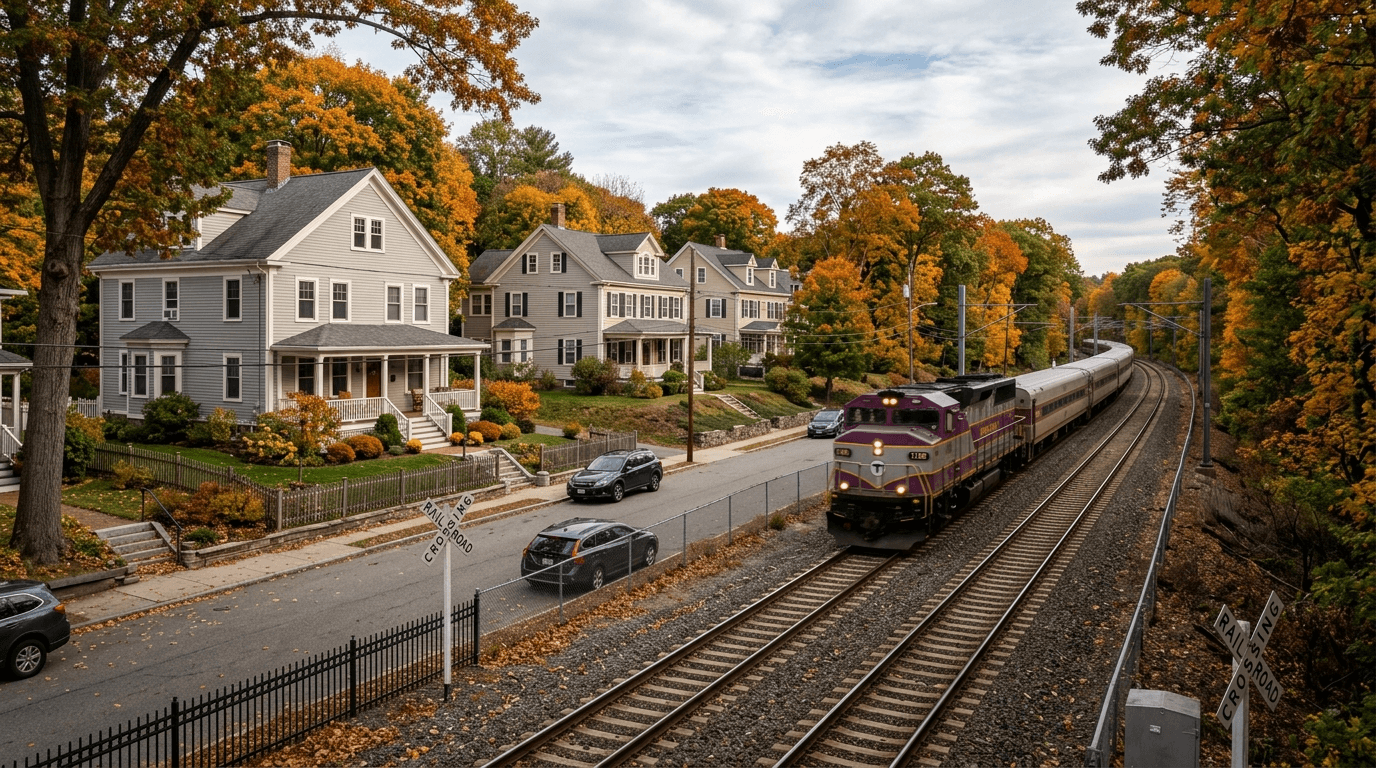
# Needham's MBTA Communities Housing Mandate: What Sellers and Investors Need to Know
Key Takeaways
•The core answer: Needham must zone for capacity of roughly 1,704 new multifamily units under the state's MBTA Communities Act, per the town's compliance plan, and most of that capacity sits near its commuter-rail corridors. Over time, that can change how nearby land is valued.
•The real shift: Qualifying apartment or triplex projects become legal "by right" — meaning no special town vote for each one. That removes a big approval hurdle and, over time, can add an option value to land even before anything is built.
•The honest caveat: So far, this is a legal change, not a proven price event. Needham's own current sales data does not yet show a development-driven price premium, so treat this as a shift to prepare for — not one to bank on today.
•The bottom line for July 2026: If your home sits inside a rezoning zone, watch for the day your neighbor's teardown starts to comp against triplex land value instead of another single-family resale. That day has not clearly arrived yet.
It's easy to treat Needham's MBTA Communities mandate as a distant paperwork problem. But the legal groundwork is now in place, and it can eventually reshape how parcels near the commuter rail are valued. This article lays out what has actually changed, what has not, and how to prepare without overreacting.
What Is the 60-Second Briefing for Needham Sellers and Investors?
Start with the number that matters.
Needham's compliance plan requires zoning capacity for about 1,704 new multifamily units — meaning triplexes, small apartment buildings, and similar structures. Most of that new capacity targets land near Needham's commuter-rail stations.
The mechanism driving this is the MBTA Communities Act, and its most consequential feature is three words: allowed "by right."
That phrase means a builder does not need a special town vote for every qualifying project. When approval gets easier, land can — over time — become more valuable. For sellers, that means your property may eventually be evaluated as more than a house. If your lot is in the right location, some buyers may one day price it as a future development site.
That is not clearly happening yet in Needham's sale prices, as the data below shows. But the direction of travel matters.
"If you own in a premium suburb like Wellesley or Needham, your equity is still protected in the near term — the market isn't being flooded with competing supply."
Key takeaway: This rule change affects the future housing pipeline. It does not mean Needham is suddenly flooded with new listings — or that land values have already jumped. It is a shift to watch and prepare for.
How Did Needham Arrive at Its Zoning-Capacity Target?
The MBTA Communities Act is Massachusetts' direct response to the regional housing shortage. The state is pushing transit-served communities to allow more homes near stations — and in Needham, that means rezoning capacity near the commuter rail.
This is not a project-by-project approval process. The town is creating broader zoning districts where multifamily housing can be permitted. That is a structural change to the rulebook, even if actual construction lags behind.
Needham is far from alone. The MBTA Communities Act applies to more than 175 cities and towns across the transit network. Each community sets its own zoning districts to meet a state-assigned capacity target, and every affected town faces the same "by right" rules — and the same slow translation from zoning language into actual buildings.
Scale matters here. Needham's target of about 1,704 units, per the town's compliance plan, is a zoning capacity figure — a ceiling on what could be built, not a forecast of what will be built. In many Massachusetts communities, actual construction has trailed well behind zoned capacity.
Key takeaway: This is a location story. The biggest potential impact in Needham is concentrated near commuter rail housing corridors — not spread evenly across every neighborhood — and capacity on paper is not the same as shovels in the ground.
Which Needham Homes Are Most Exposed to the Zoning Change?
Not every Needham homeowner should react the same way. The key question is straightforward:
Is your parcel inside the rezoning area near transit, or outside it?
Here is how exposure breaks down:
•Highest exposure — older single-family homes near transit. These are the most likely teardown-to-triplex candidates. Over time, their "highest and best use" — the most valuable legal use of the land — could shift from resale home toward development site.
•High exposure — older condos near transit. This segment is already moving more slowly, as the data below shows.
•Lower exposure — homes outside the transit radius. These properties are still driven by lifestyle, schools, yard space, and neighborhood feel.
That condo-versus-house gap is already visible — and it complicates the development story rather than confirming it.
Over the last 180 days, Needham condos took a median of 92 days to sell. Single-family homes moved in just 20 days, despite similar median prices. Inventory sits at roughly 4.0 months for condos versus 3.4 months for single-family homes — and in plain terms, months of inventory measures how long it would take to sell all current listings at the recent sales pace, so a higher number signals a slower segment.
Needham Market Speed by Property Type — Last 180 Days
A side-by-side snapshot of Needham single-family and condo market conditions using MLSPIN activity from the last 180 days.
Single-family
Condo
| Series | Label | Value |
|---|---|---|
| Single-family | Median sold price | 1856500 |
| Single-family | Median days on market | 20 |
| Single-family | Months of inventory | 3.4 |
| Condo | Median sold price | 1770000 |
| Condo | Median days on market | 92 |
| Condo | Months of inventory | 4.0 |
Source:Repliers / MLSPIN
This cuts against a simple "transit-adjacent means rising value" narrative. Condos are the most transit-proximate, apartment-style product Needham already has — and right now, buyers are taking far longer to absorb them. If a development-driven premium were already showing up, you would not expect this segment to be lagging. Read it as a caution flag: rezoning changes what is legally possible on land, but current buyers are not yet paying up for denser, transit-adjacent product.
As one local read on the market put it:
"These buyers are prioritizing walkability and school quality, not just rental math."
What this means for you: Before you pick your comps, confirm whether your property is inside or outside the rezoning district. But do not assume "inside" automatically means "worth more today" — the sale data does not yet support that.
How Do Appraisers and Buyers Start Repricing Comps?
Here is where the math could shift over time.
A comp is a comparable sale — the nearby transactions appraisers use to estimate what your home is worth. Normally, they compare similar homes: same style, lot size, condition, and location.
But when a lot can legally hold a triplex by right, the value of the land itself can, in principle, change. An older single-family home near transit might eventually compare less with a renovated resale and more with a teardown lot priced for future multifamily use. That could help some sellers — if a real second buyer pool of developers or investors materializes and pays a premium.
Right now, though, there are real brakes on that upside — and they are winning.
The broader market has cooled. Over a recent three-month window, Needham's median sale price was down 4.7% year-over-year and price per square foot was down 2.6%, according to Redfin. A market with falling prices is not one where a zoning change is visibly inflating land values.
New upscale rentals are also tightening investor math. As one market note observed:
"New Class A buildings are offering one to two months of free rent to fill units."
Free rent lowers a landlord's real income. Lower income means investors may pay less for land, not more — which directly undercuts the idea that rezoning is lifting land values right now. The very buyers who would pay a development premium are being squeezed.
Key takeaway: The zoning change creates the legal option for higher land value later. But higher rates, softer rents, and falling prices mean that option is not translating into a premium today. This is a "watch and prepare" story, not a "cash in now" one.
Who Is Not Deeply Affected by This Yet?
For many Needham homeowners, the day-to-day market still looks familiar.
If your home sits outside the likely transit-focused rezoning area, near-term impact data shows comps stay single-family and are driven by schools and walkability. Move-in-ready single-family houses are still selling fast — a median of 20 days, per the data below (MLSPIN), which aligns with current Redfin figures as well.
Near-Term Impact by Owner Type
Compares near-term impacts of Needham's July 2026 MBTA Communities zoning reset across owner and investor types.
| Category | Near-Term Impact |
|---|---|
| Homeowners outside the transit radius | Comps stay single-family, driven by schools and walkability |
| Sellers of move-in-ready houses | Still selling fast — a median of 20 days, per MLSPIN |
| Owners expecting an instant building wave | Capacity is potential, not immediate supply |
| Small investors chasing high rents | Soft rent and concessions make triplex math tighter |
Source:Repliers / MLSPIN
There is also an important edge case worth noting. Upzoning a district does not mean every parcel inside it changes in the same way. In other states' rollouts, many parcels have been exempted — hillside fire zones and historic overlay areas in the Los Angeles plan, for example, according to the Los Angeles Times. Needham owners should expect similar details to matter as the town finalizes its districts.
Key takeaway: For most owners today, schools and lifestyle still drive price. The land-value story is real as a legal change, but so far it is concentrated, gradual, and not yet visible in prices.
What Should Sellers and Investors Do for the Rest of 2026?
Your best move depends on where your parcel sits.
What Should You Do If You Are Selling Inside the Transit Radius?
Get two valuations, not one.
You need a normal resale-comp estimate and a land-value estimate. Your home might one day be worth more as a development site than as a house — but be realistic. With rates high and investor math tight, a development-site premium only exists if a willing developer-buyer actually shows up. In today's market, that buyer may not be there. Price against real, current comps first, and treat any development premium as a possible bonus, not a baseline.
Also understand the difference between assessed value and market value. Assessed value is the town's tax figure — the number used to calculate your property tax. Market value is what a real buyer will actually pay. On a teardown lot, those numbers can be far apart.
What Should You Do If You Are Selling Outside the Transit Radius?
Lean into what buyers still want most:
•Strong presentation and curb appeal
•Clean condition
•School-district strength
•Neighborhood lifestyle
•Single-family scarcity
Needham is not suddenly oversupplied. Good homes can still move quickly when they are priced and prepared well.
What Should You Do If You Are a Small Investor?
Do not assume every triplex deal works. Re-run the numbers with real-world costs, including:
•Higher financing costs
•Slower lease-up timing
•Possible rent concessions
•Construction risk
•Resale uncertainty
A zoning win is not a profit guarantee. And this is exactly why sellers should be cautious about counting on a development premium — if the deals do not pencil out for investors, there is no one to pay that premium.
What Should You Do If You Are a Long-Term Homeowner?
Your near-term equity is still driven by Needham's core strengths: schools, location, and limited detached-home supply. But watch the pipeline.
The real signal is not zoning language. It is the day rezoned parcels start turning into actual permits, land sales at a developer premium, and construction activity. Until then, treat the land-value thesis as a possibility, not a fact.
What Are the Strongest Arguments Against This View?
A fair answer takes the pushback seriously. There are two strong objections.
Does Zoning Capacity Matter If Nothing Gets Built?
The objection is fair, and the current data largely supports it.
Zoning creates legal capacity — not buildings. High land costs and interest rates may keep many developers on the sidelines for years. Needham's days on market rose from 16 days last year to 20 days now, per Redfin, signaling buyers are taking more time. Builders are likely being more careful, too.
The honest answer is heavily qualified. Legal capacity has potential value: once a parcel can hold a triplex by right, a future buyer might one day pay for that option. But "might one day" is not "already." Zoned capacity will not translate into buildings overnight, and the current market is not yet paying a clear premium for the right to build. This is why we frame the mandate as a shift to prepare for, not a price event that has already landed.
How Should You Weigh the Assessor's Backward-Looking Data Against Fresher 2026 Trends?
The two data sets describe different points in time — and the older figure should not anchor a 2026 pricing decision.
The town's past assessment data showed a 22.28% jump in average single-family value, to $1,464,398.
Town Assessment Signal: Single-Family Values Rose Sharply
Town assessment data showing the reported change in average single-family property values and the timing basis for those assessments.
Needham single-family assessments
Average residential single-family property value percent increase22.28%
Average residential single-family property value$1,464,398
Assessment timing
Assessments represent market value as ofJanuary 1, 2024
Sales data period referencedJanuary to October of 2024
That figure is backward-looking by design. It reflects market value as of January 1, 2024, using sales from January through October of 2024 — it tells you where the market was, not where it is now.
The fresher trend points the other way. Redfin's May 2026 data shows the median price and price per square foot both easing year-over-year — a 4.7% dip in median price and a 2.6% dip in price per square foot. For a timing decision in July 2026, that newer, softer trend line matters far more than the older assessment jump.
What this means for your wallet: Do not anchor your price to an older assessment figure. Use current buyer behavior, current comps, and your parcel's zoning position.
What Is the Bottom Line for Needham Sellers and Investors?
Needham's MBTA Communities Act compliance target — zoning capacity for about 1,704 multifamily units near transit, per the town's plan — is a real structural change to the rulebook.
Over time, it can shift the value conversation around commuter-rail-adjacent land. But that shift is one to prepare for, not one the current data shows has already arrived. Needham's own recent numbers — prices easing year-over-year, condos taking far longer to sell than single-family homes, rentals offering free months to fill units — all point to a market that is not yet paying a development premium.
If your property sits inside a rezoning area, your lot may eventually be viewed through a development lens. That could help your value — but only if the investor math works and a real buyer appears.
If your home sits outside the affected area, the story is steadier. Schools, neighborhood feel, walkability, and single-family scarcity still carry the market.
The smartest move right now is straightforward:
Find out which value track your property is on — resale value, land value, or both — and watch for the first real signs of local development activity before you act on the land-value thesis.
If you want to know how Needham's zoning-capacity target might affect your specific address, request a parcel-level valuation before you sell, refinance, or make an investment decision.