# Somerville Neighborhoods Map: 19 Areas to Know From Assembly Square to Teele
Key Takeaways
•A big factor that sorts Somerville's neighborhoods today is your walk to a train. The Green Line Extension added new subway stops across the city, and your commute now shapes much of your daily life here.
•Tier One anchors (Davis Square, Assembly Square) cost the most but resell the strongest. They have had decades of transit access already priced in.
•The value play sits in the Green Line winners — Union Square, Gilman, Magoun, and Ball Square — where prices are still catching up to newer train access, though the transit premium itself is modest.
•Bus-dependent pockets like Teele Square and East Somerville offer lower entry prices, but the highway exposure in some of these areas carries real health costs.
How Should You Read Somerville's Neighborhood Map?
Most people start with a simple question: "Which Somerville neighborhood is best?"
The better question is: How close do you want to be to a train?
That answer shapes your budget, daily routine, resale strength, and how often you use a car. A few blocks can change everything.
Here's the baseline. Per the City of Somerville, the city has about 81,045 people, a median household income of $124,110, and 72.6% of adults holding a bachelor's degree or higher.
Somerville Demographics and Household Economics
Selected census and ACS indicators from Somerville’s 2025–2035 Open Space and Recreation Plan.
Population
Total Population81,045
Median Age31.4
Economics
Median Household Income$124,110
Poverty Rate10.2%
Housing
Median Home Value$860,500
Education
Bachelor's Degree or Higher72.6%
The city-wide median home value sits around $860,500 across all property types. Because everything here is packed close together, short distances matter more than they would elsewhere.
For decades, transit access was uneven. According to the Boston Globe, just 15 percent of the workforce once worked in Somerville or lived within walking distance of Davis or Sullivan Square. After the Green Line Extension, the City of Somerville projected that 85 percent of residents would live within walking distance of an MBTA station. Train proximity is now less about who has it and more about which pockets have already priced it in.
Here are the 19 Somerville areas to know:
•Assembly Square
•Davis Square
•Union Square
•Gilman Square
•Magoun Square
•Ball Square
•Teele Square
•East Somerville
•Ten Hills
•Winter Hill
•Spring Hill
•Prospect Hill
•Central Hill
•Powder House
•Porter Square edge
•Sullivan Square edge
•Brickbottom / Inner Belt
•Cobble Hill
•West Somerville
Let's rank them by what actually matters to buyers: train access, walkability, and price tier.
Which Two Neighborhoods Set the Price Ceiling?
Davis Square and Assembly Square are the anchors. Every other pocket gets priced against them.
Davis Square has been on the Red Line since 1984 — a 40-year head start. It's a cultural hub, with the 1914 Somerville Theatre, The Burren, restaurants, and constant foot traffic. Most errands don't require a car. You pay a premium here, but resale strength is usually the biggest payoff.
Assembly Square is the polished newer option. Its Orange Line station opened beside the $1.2 billion Assembly Row development, per the Boston Globe. Think high-rise condos, outlet retail, newer buildings, and waterfront access.
Davis is historic and square-centered. Assembly is newer, glossy, and waterfront-oriented.
Best for: buyers who want convenience, strong resale, and less guesswork.
Which Green Line Neighborhoods Offer the Best Value?
The Green Line Extension changed the map for Union Square, Gilman Square, Magoun Square, and Ball Square. These pockets were transit-poor for generations. Now they have rail access, and prices are still catching up.
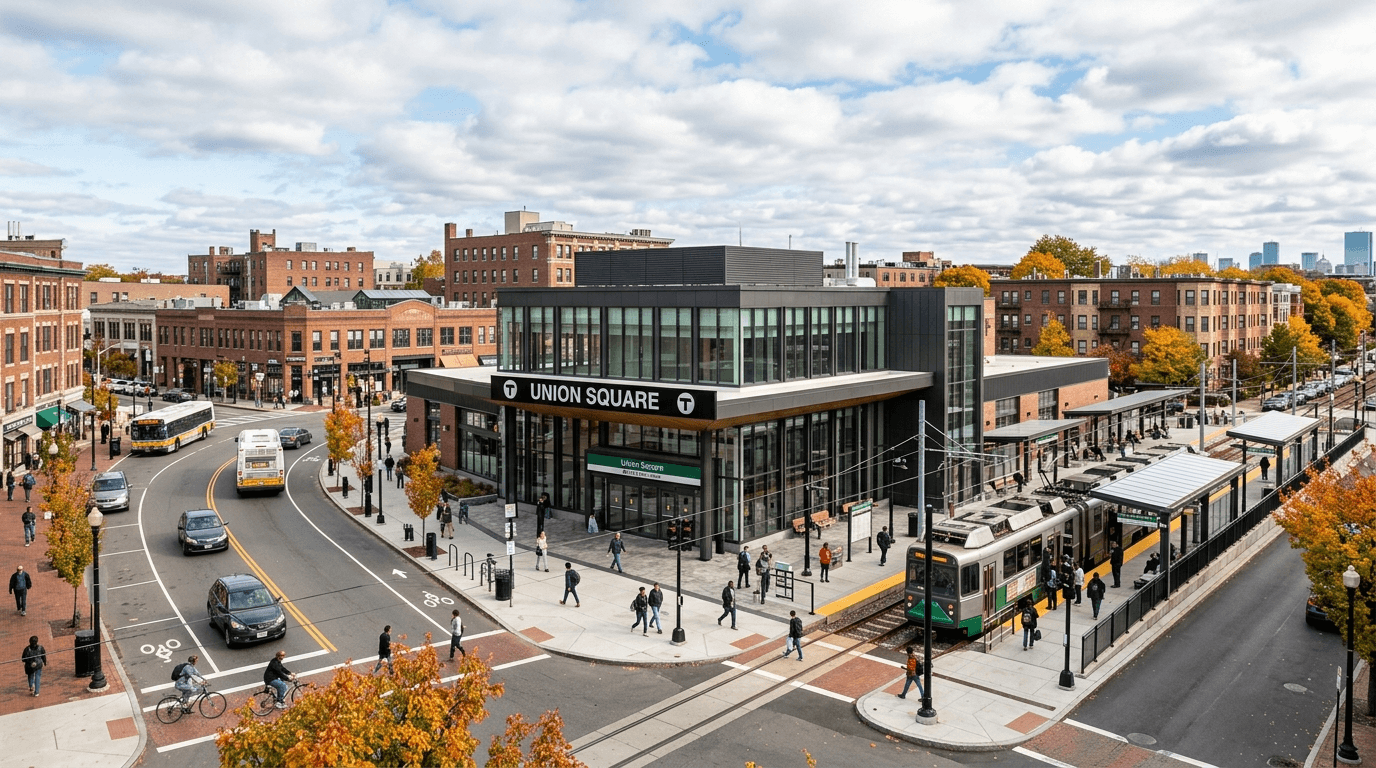
Union Square is the headliner. Its new Green Line station anchors a 3.8-acre redevelopment site slated for up to 600,000 square feet of new building, per the Boston Globe. The city projected 17,300 new jobs and 3,600 homes around Union Square and Washington Street, per the Boston Globe.
Union is also one of Somerville's strongest food neighborhoods, with spots like Celeste, Juliet, and Bow Market.
Gilman Square, Magoun Square, and Ball Square feel more residential, with single-family and two-family homes lining quiet side streets.
Stay realistic about the premium, though. Homes within about half to three-quarters of a mile of a Green Line stop tend to sell for 5 to 10 percent more, according to Stephen Bremis of Bremis Realty, speaking to the Boston Globe.
That's a real edge, but a modest one. Citywide, the median single-family sale price rose nearly 20 percent — from $450,000 to $539,000 — as extension momentum built, per Warren Group data cited by the Boston Globe. That's a Somerville-wide figure, not a per-neighborhood number, so treat it as broad context rather than a guarantee. There's also a real risk these newer stations simply follow Davis and Assembly's path — converging toward the top tier instead of staying a discount.
Best for: buyers who want modest upside and are willing to buy before a neighborhood feels fully "finished."
Which Pockets Still Depend More on Buses?
Not every area shares the same rail advantage. Some pockets still lean on the city's MBTA bus network, which can mean a lower entry price but a different daily rhythm.
Teele Square sits near the Arlington line, with character, restaurants, and a neighborhood-square feel. But it's a longer walk or bus ride to the Davis Red Line — good if you want West Somerville charm without full Davis prices.
East Somerville and Ten Hills are more mixed. Parts of East Somerville benefit from the Washington Street Green Line stop; other parts feel more bus-dependent or highway-adjacent.
Weigh the health trade-off before choosing these areas. I-93 sends about 150,000 vehicles past the city each day, with up to 60,000 more on Route 28 (Boston Globe). A study by Wig Zamore linked those highways to higher rates of lung cancer and heart-attack deaths nearby, finding 35 excess deaths per square mile near the highways, versus 3 in Milford.
Non-car commuting rules citywide, with 46.8% of residents using transit, walking, or biking versus 34.1% who drive.
How Somerville Residents Commute
Primary commute mode shares for Somerville residents in 2020.
| Series | Label | Value |
|---|---|---|
| Commute Mode (2020) | Drove to work | 34.1% |
| Commute Mode (2020) | Public transit, walking, or biking | 46.8% |
| Commute Mode (2020) | Worked from home | 12.7% |
A bus-only pocket will feel very different day to day from one with a five-minute walk to rail. The same data shows 12.7% work from home — a real share, but still a minority.
Best for: buyers who need a lower price point and can accept the air-quality and resale trade-offs near the highways.
What Are the Strongest Arguments Against Ranking by Transit?
The first fair pushback: "I work from home, so why pay for a train?" That's reasonable, and the data backs part of it — 12.7% work from home. But that's still a minority. Most residents commute, and train access also shapes restaurants, shops, foot traffic, rental demand, and resale.
The second pushback: "A new station doesn't automatically make every street better." Also true. Station-adjacent areas can bring more noise, density, and less parking. If you want quiet, a slightly farther pocket may suit you better.
The third, and most important: the Green Line Extension's multi-billion-dollar price tag proves the region invested, not that any single neighborhood gained value or ridership. Using a project's cost to rank neighborhoods would be a leap, and we'll concede that. The evidence that actually supports sorting by transit is narrower: Bremis's 5-to-10-percent proximity observation and the Warren Group's citywide sale-price movement, both via the Boston Globe. Those are modest, real signals — not proof of outsized upside.
So the goal isn't to claim rail is always best. It's to use transit as one clear sorting signal among several.
How Should This Shape Your Offer in 2026?
Somerville Neighborhood Transit-Access Tiers
Compares Somerville neighborhood pockets by transit-access tier and buyer rationale for evaluating offers in 2026.
| Category | Pockets | Why buy here |
|---|---|---|
| Anchors | Davis, Assembly | Top price, strongest resale stability |
| Green Line winners | Union, Gilman, Magoun, Ball | Value still catching up to new access |
| Bus-fringe | Teele, East Somerville, Ten Hills | Lower entry price, real trade-offs |
Use the map in three tiers. For the top-price, strongest-resale tier, start with Davis Square and Assembly Square. For areas where value is still catching up to newer access, focus on Union, Gilman, Magoun, and Ball Square. For a lower entry price, look at Teele, East Somerville, and Ten Hills — but price in the real air-quality and resale trade-offs near the highways.
One budget note matters in 2026: you can now openly negotiate how much you pay your own agent as part of your offer, following a recent update to the standard Massachusetts purchase contract (Boston Agent Magazine). Confirm the current commission rules with your agent before you write an offer.
The bottom line is simple: in Somerville, you're not just buying a home. You're buying a daily path — to the train, to dinner, to work, and to the rest of Boston.
To compare specific numbers across these neighborhoods, ask your agent for a neighborhood-by-neighborhood pricing breakdown before you write an offer.